AI Model Lifecycle in Amazon Bedrock: How to Protect Business Application Continuity
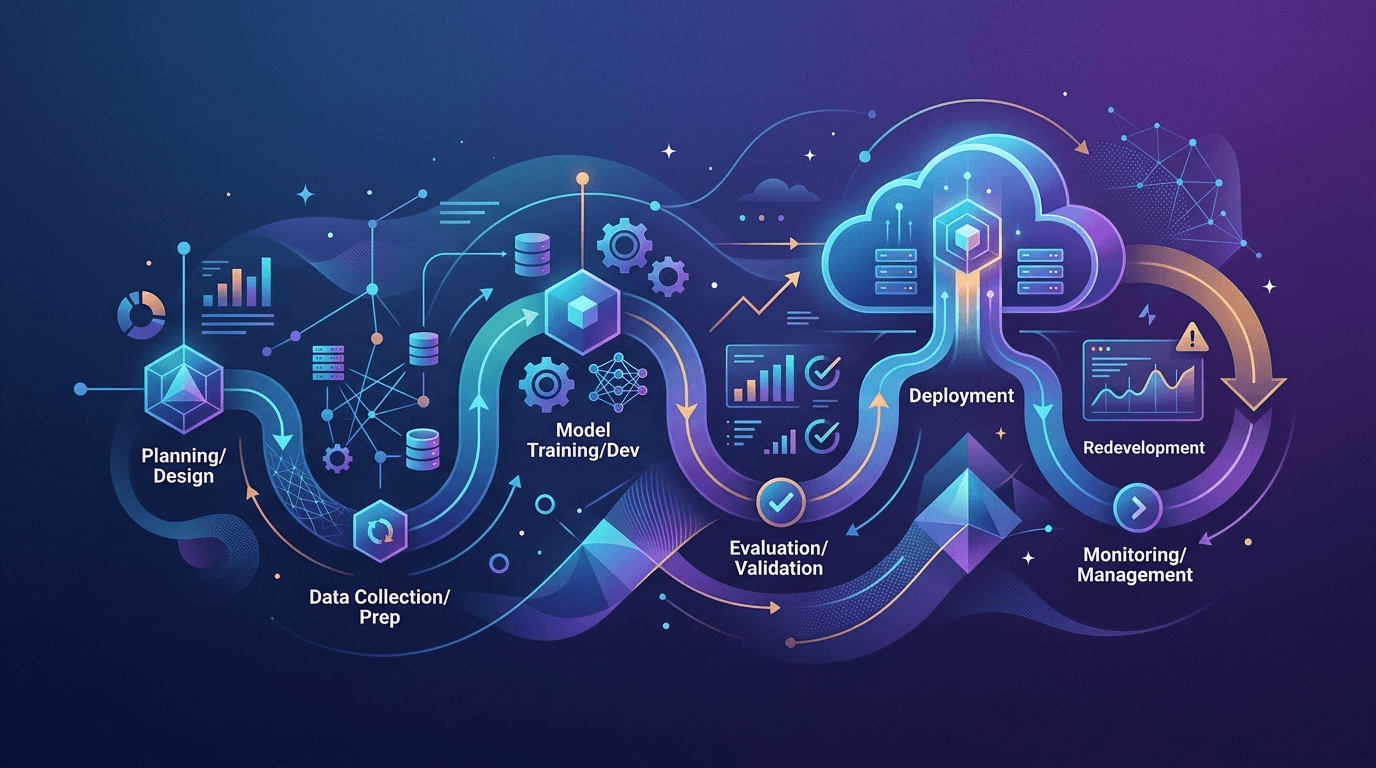
You've deployed an AI application in production. Your teams rely on it daily. Then one morning, you receive a notification: the model that underpins your entire processing pipeline is being deprecated. Panic stations? Not necessarily — provided you've anticipated the lifecycle of your foundation models.
This is precisely the issue raised by Amazon Web Services in its recent publication on managing model lifecycles in Amazon Bedrock. For French enterprises accelerating their adoption of generative AI, this isn't just a technical matter: it's a question of operational resilience and governance.
The Three Lifecycle States: What Every CIO Must Know
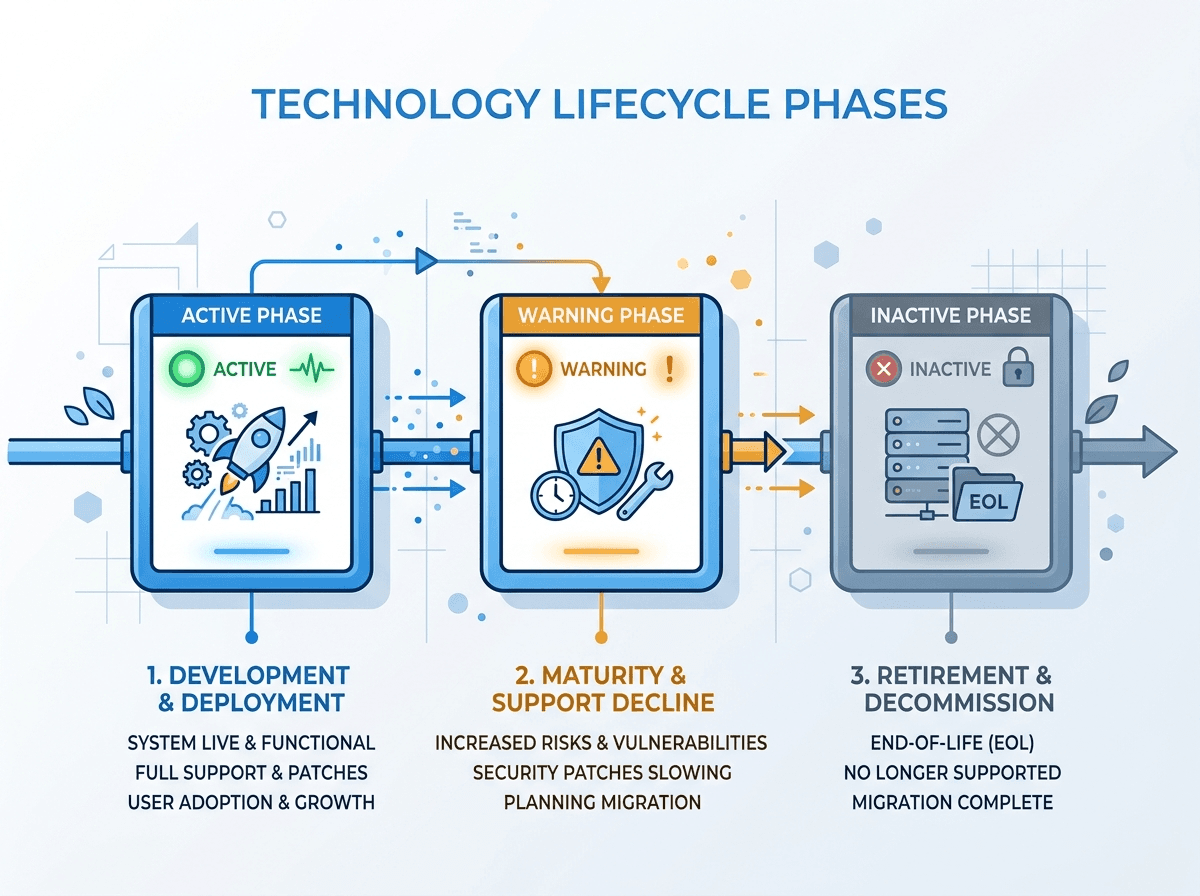
Amazon Bedrock structures the lifecycle of its Foundation Models (FM) into three distinct phases that every IT team must integrate into its roadmap:
Available: the model is fully operational, accessible via the API, and supported. This is the nominal phase during which your applications run without constraint.
Deprecated: the model reaches end-of-life. AWS announces a cutoff date. API calls continue to function temporarily, but it's strongly discouraged to base new development on this model.
Retired: the model is no longer accessible. Any application calling it will return an error. This is the catastrophic scenario for an enterprise that hasn't anticipated migration.
For a manufacturing SME in the Lyon region using Bedrock to automate compliance report analysis, or for a Paris consulting firm that has integrated an AI assistant into its CRM, reaching the "Retired" phase without a migration plan means unplanned service interruption — with all the implications for lost productivity and eroded trust.
Extended Access: Buying Time for Smooth Migration
AWS introduces a pragmatic response to this challenge with the Extended Access feature. Concretely, it allows enterprises to continue using a deprecated model beyond its official retirement date, through specific configuration in their Bedrock account.
This option is not a permanent solution — it should not be viewed as a way to ignore migrations — but it offers a valuable safety net for organizations with long development cycles or constrained technical resources.
Imagine a regional mutual insurance company that has developed a reimbursement request processing workflow based on Claude 2. Migration to Claude 3 involves revalidating all prompts, testing outputs on sensitive business datasets, and training teams on the new model behavior. With extended access, this migration can happen over an entire quarter, without interruption risk, and with the rigor required by the regulated sector.
Strategically, here's how to exploit this window:
- Immediately audit all models used in production and their status in Bedrock
- Prioritize migrations based on business impact of each application
- Test in parallel: run the old and new model simultaneously on real cases before definitive switchover
- Document behavior differences between versions to avoid surprises in production
Disruption-Free Migration Strategies: Field Best Practices
Migrating a foundation model isn't just about changing an identifier in a line of code. It's an operation that affects output quality, user experience consistency, and sometimes regulatory compliance.
Versioning and API call abstraction: the first golden rule is never to hardcode a model in your business logic. Use an abstraction layer — a configuration variable, a secret manager parameter — that lets you swap models without touching application code. This seemingly simple practice saves weeks of work during forced migration.
Systematic comparative evaluation: before any switchover, build a test suite representative of your real use cases. A food distributor using AI to generate product sheets must verify that the new model respects the same constraints on tone, length, and nutritional accuracy. This evaluation is non-negotiable.
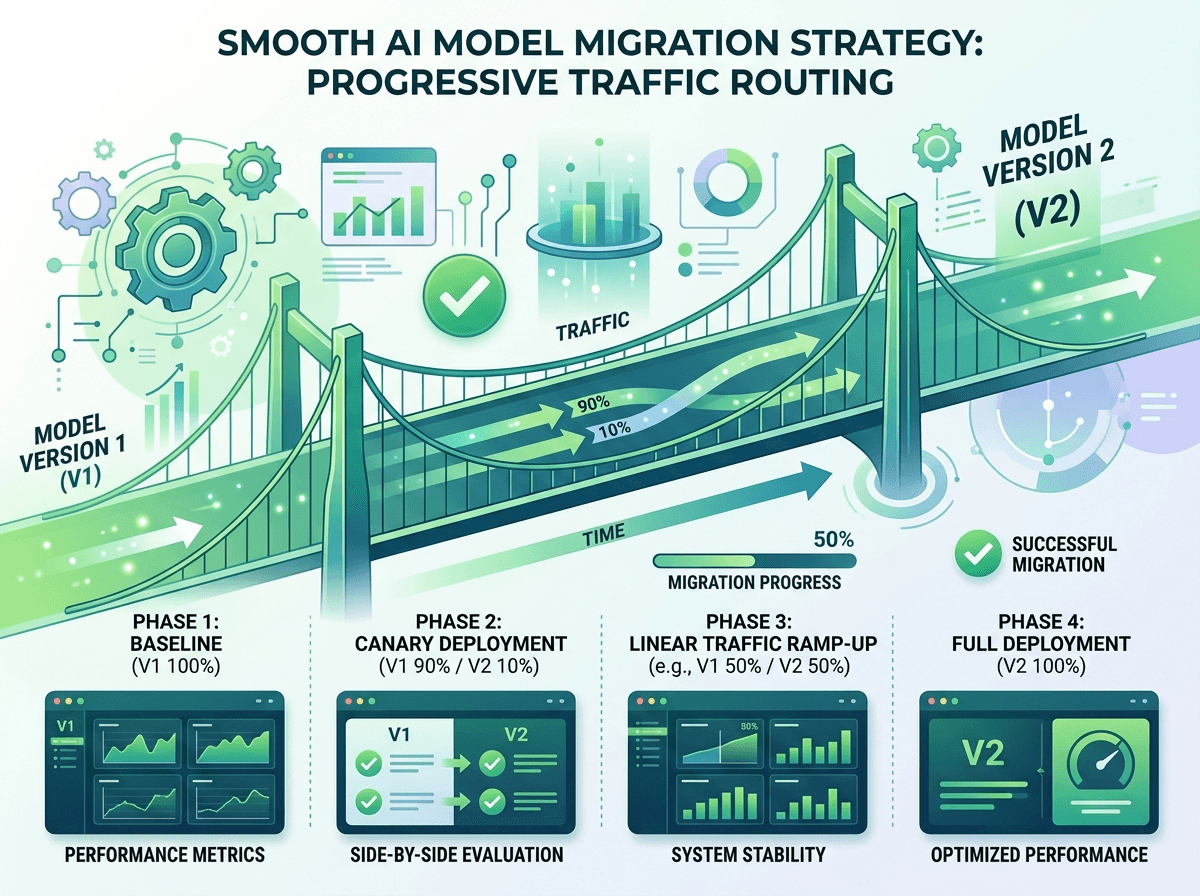
Progressive migration with feature flags: rather than a brutal switchover, route increasing percentages of traffic to the new model. 5% the first week, 20% the second, up to 100% once confidence is established. This approach, borrowed from DevOps best practices, applies perfectly to AI model transitions.
Enhanced post-migration monitoring: metrics to track aren't purely technical (latency, error rate). Include business indicators: output validation rate by users, volume of manual corrections, team satisfaction. A technically superior model can degrade experience if its behavior differs too much from what users are accustomed to.
Training Your Teams: The Human Dimension of AI Transitions
Behind every model migration lies a training challenge that French enterprises too often underestimate. Developers who built their prompts around a model's specifics must understand the nuances of the new one. Business teams who learned to interpret outputs must be guided through adopting new capabilities — and new limitations.
This involves multiple levels of skills development:
- Technical teams must master lifecycle concepts, model versioning, and comparative evaluation. MLOps culture — which includes model lifecycle management — must become standard practice, not an exception.
- Product managers and project leads must integrate migration windows into their schedules, just like framework updates or regulatory changes.
- Business users must understand that the AI they use daily evolves, and be equipped to flag behavioral drift.
At Ikasia, we observe that enterprises getting the most from their AI investments are those that have structured a culture of continuous monitoring and adaptation. It's not a single IT team's responsibility: it's a cross-functional issue involving leadership, business units, and technology partners.
The lifecycle of AI models isn't an abstract technical constraint. It's a strategic parameter that determines the sustainability of your artificial intelligence investments. French enterprises that integrate it today into their AI governance will be those that transform every market evolution into competitive advantage rather than operational crisis.
Want to audit your AI applications and structure a model governance strategy adapted to your context? The Ikasia team supports French enterprises in implementing robust and sustainable AI practices. Discover our training programs and consulting offerings at ikasia.ai and let's discuss your concrete challenges.
Tags
Related courses
Related articles
Master Your AI Costs in Enterprise: Amazon Bedrock Projects Changes the Game
Read
AI Code Generation in Enterprise: How Amazon Bedrock Guardrails Protect Your Workflows Without Compromising Productivity
Read
Autonomous AI in the Enterprise: What OpenAI's New Security Risks Reveal for Your Organization
ReadWant to go further?
Ikasia offers AI training designed for professionals. From strategy to hands-on technical workshops.