How to Train 500 Employees on AI in 90 Days: A Playbook for Enterprise L&D Leaders
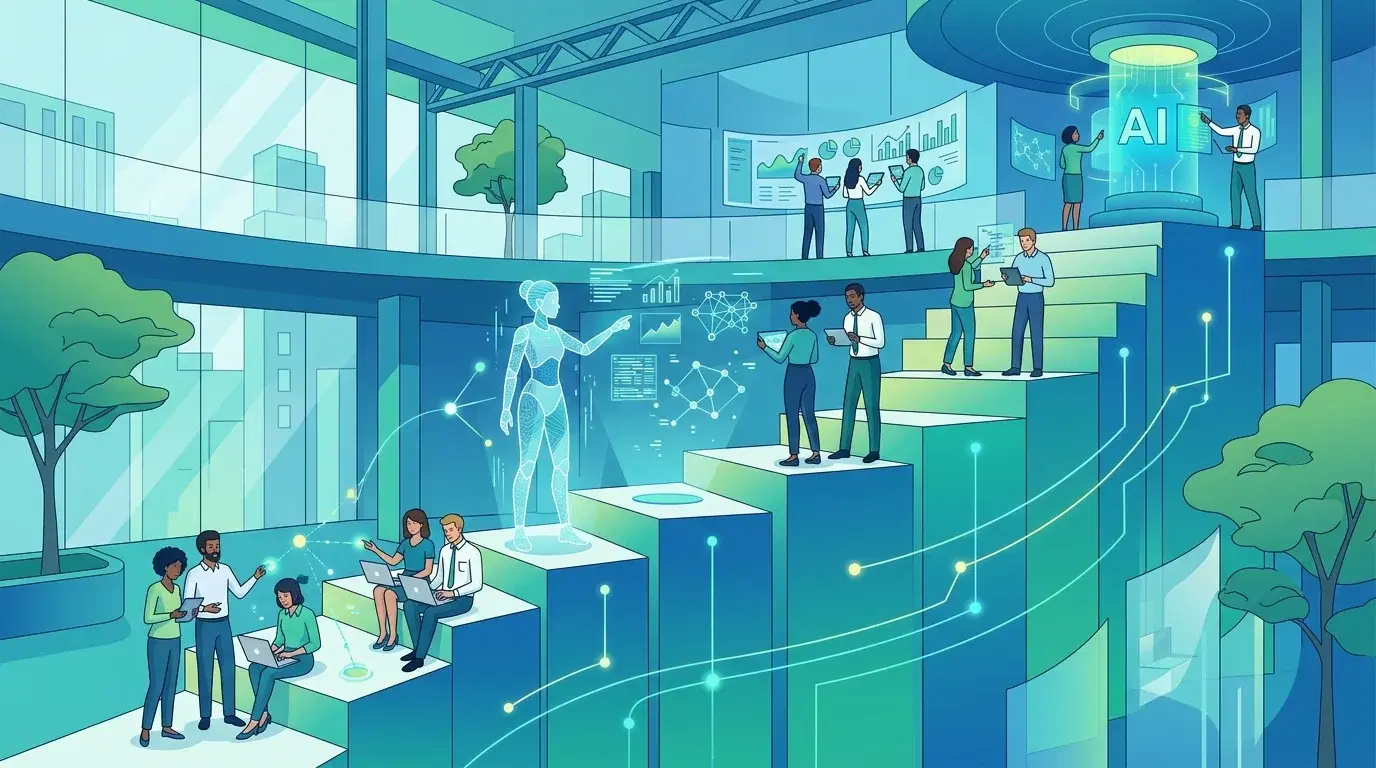
Rolling out AI training to hundreds of employees is not a matter of buying 500 LinkedIn Learning subscriptions. It requires sequencing, relevance, measurement, and cultural change. This playbook distills what we have learned from training over 3,000 professionals across CAC 40 companies, mid-caps, and public sector organizations.
Key takeaways: Training 500 employees on AI in 90 days requires a phased approach: Week 1-2 (diagnosis and ambassador recruitment), Week 3-6 (pilot cohort and format validation), Week 7-10 (department-wide rollout), Week 11-12 (measurement and scaling planning). Success depends on role-based curricula, executive sponsorship, and metrics tied to business outcomes — not just completion rates.
Phase 1: Diagnosis and Foundation (Weeks 1–2)
Step 1: Map AI readiness across roles
Not everyone needs the same training. A data scientist and a sales manager have different AI literacy gaps. Before designing content, segment your population:
| Profile | AI Literacy Gap | Priority Format |
|---|---|---|
| Executives & Board | Strategic framing, ROI understanding, governance | 1-day executive seminar |
| Managers | Productivity tools, prompt engineering, team enablement | 2-day hands-on workshop |
| Knowledge workers | Daily AI tools (Copilot, ChatGPT, Midjourney), responsible use | Half-day bootcamp + self-paced |
| Technical staff | RAG, fine-tuning, MLOps, security | 3-5 day deep-dive |
| Operational staff | Process automation, voice-to-text, quality control | Micro-learning (15 min/day) |
Tool: Deploy a 10-question self-assessment survey to all 500 employees. Score each person on familiarity (never used / experimented / regular user / advanced) and confidence (anxious / curious / confident / expert).
Step 2: Recruit AI ambassadors (1 per 25 employees)
Ambassadors are not trainers. They are peer coaches who:
- Attend the pilot and master the content
- Answer day-to-day questions from colleagues
- Collect feedback and escalate blockers
- Model the behavior (use AI openly, share wins)
Selection criteria:
- Early adopters (already experimenting with AI)
- Respected by peers (not necessarily senior)
- Available (5-10% of time for 3 months)
- Cross-functional (represent all major departments)
For 500 employees, recruit 20 ambassadors. Train them 2 weeks before the main rollout.
Step 3: Secure executive sponsorship
Without visible C-suite support, AI training becomes "another HR initiative." Secure:
- A kick-off email from the CEO or CHRO
- Calendar protection (training time is non-negotiable)
- Budget for external facilitators if internal capacity is insufficient
- Success metrics approved by the Executive Committee
Phase 2: Pilot and Validate (Weeks 3–6)
Step 4: Run a pilot cohort (50 employees)
Select a representative cohort: 10 from each major department, mixed readiness levels, including skeptics. Run the full curriculum and collect ruthless feedback.
Pilot curriculum template (Managers track)
| Day | Morning | Afternoon |
|---|---|---|
| 1 | AI landscape: what changes, what doesn't | Hands-on: ChatGPT / Copilot for daily tasks |
| 2 | Prompt engineering fundamentals | Workshop: solve a real work problem with AI |
| 3 | Responsible AI: bias, confidentiality, hallucinations | Peer teaching: each participant trains a colleague |
Feedback mechanisms:
- Daily pulse survey (1-5 satisfaction, 1 question)
- End-of-pilot focus group (8-10 volunteers)
- Manager interviews (did behavior change?)
Step 5: Iterate the curriculum
Based on pilot feedback, adjust:
- Pacing: Too fast? Add a half-day. Too slow? Cut theoretical content.
- Relevance: Replace generic examples with real company documents (anonymized).
- Tools: If employees use Microsoft 365, focus on Copilot. If they use Google Workspace, focus on Gemini.
Golden rule: Pilot feedback is not optional. We have seen companies skip the pilot and waste €150,000 on training that employees found irrelevant.
Phase 3: Department-Wide Rollout (Weeks 7–10)
Step 6: Sequence by department, not by individual
Rolling out 500 people simultaneously creates chaos. Roll out one department per week, supported by the ambassador assigned to that department.
Example sequence:
- Week 7: Marketing & Sales (early adopters, visible wins)
- Week 8: Operations & Finance (process-heavy, high ROI potential)
- Week 9: HR & Legal (risk-aware, need governance framing)
- Week 10: IT & R&D (advanced users, peer-to-peer learning)
Step 7: Blend formats for scale
No single format works for 500 people. Use a 70-20-10 blend:
| Format | Share | Description |
|---|---|---|
| On-the-job practice | 70% | Weekly "AI challenge" (e.g., "Use AI to shorten this report by 50%") |
| Peer learning | 20% | Ambassador-led lunch-and-learns, Slack/Teams channels |
| Formal training | 10% | In-person workshops, e-learning modules, certification |
Micro-learning for operational staff:
- 15-minute daily modules for 4 weeks
- Mobile-friendly (many operational staff do not sit at a desk)
- Gamified (badges, leaderboards, team competitions)
Step 8: Address the skeptics
20-30% of employees will resist. Common objections and responses:
| Objection | Response |
|---|---|
| "AI will replace me" | "AI handles repetitive tasks so you can focus on judgment and relationships." |
| "I don't have time" | "The first hour saves you two hours this week." |
| "This is just a trend" | "Show a competitor already using AI to serve customers faster." |
| "I'm too old to learn" | "AI is designed to be intuitive. Our oldest participant is 62 and now trains others." |
Tactic: Pair each skeptic with an ambassador who had the same objection 4 weeks ago.
Phase 4: Measure and Scale (Weeks 11–12)
Step 9: Measure what matters
Avoid vanity metrics like "completion rate" or "hours trained." Measure business outcomes:
| Level | Metric | Target |
|---|---|---|
| Reaction | Net Promoter Score of training | > 50 |
| Learning | Post-test vs. pre-test score delta | +40% |
| Behavior | % employees using AI weekly (self-reported + system logs) | > 60% |
| Results | Time saved per employee per week (measured on pilot tasks) | > 2 hours |
| Business | Projects delivered faster, customer satisfaction, cost reduction | TBD by department |
Tool: Run a 30-60-90 day survey:
- Day 30: Are you using AI? What for? What blocks you?
- Day 60: Has your workflow changed? What tasks have you eliminated?
- Day 90: What business impact have you observed?
Step 10: Plan for sustainability
Training is not a one-off event. Build the infrastructure for continuous learning:
- AI Helpdesk: A Teams/Slack channel staffed by ambassadors + external experts
- Monthly Showcases: Employees present their best AI use cases (15 min each)
- Quarterly Refresh: Update curriculum as tools evolve (GPT-5, new Copilot features, etc.)
- Advanced Tracks: For employees who want to go deeper (RAG, agents, automation)
Common Pitfalls and How to Avoid Them
Pitfall 1: Training everyone the same way
Reality: A developer needs Python + LLMs. A sales rep needs prompt engineering + CRM integration. Same content for both = relevance for neither. Fix: Role-based tracks from Day 1.
Pitfall 2: No practice, only theory
Reality: Employees sit through 4 hours of slides and forget 90% within a week. Fix: 70% of time must be hands-on with real work documents.
Pitfall 3: Measuring completion, not behavior change
Reality: 100% completion rate with 0% behavior change is a failure. Fix: Track weekly usage, not just attendance.
Pitfall 4: Ignoring the "shadow AI" problem
Reality: Employees already use free ChatGPT for sensitive work. Training them on approved tools reduces risk. Fix: Acknowledge shadow AI, explain the risks, and offer superior approved alternatives.
Pitfall 5: Stopping after 90 days
Reality: AI tools evolve monthly. Skills atrophy without reinforcement. Fix: Budget for quarterly refreshers and an AI learning community.
Budget Estimate for 500 Employees
| Item | Cost | Notes |
|---|---|---|
| External facilitators (pilot + rollout) | €30,000 – €60,000 | Depends on duration and seniority |
| E-learning platform / licenses | €10,000 – €20,000 | Annual |
| Ambassador incentives | €5,000 – €10,000 | Gift cards, recognition, time credit |
| Internal communication | €2,000 – €5,000 | Posters, videos, kick-off event |
| Total | €47,000 – €95,000 | ~€100–€190 per employee |
ROI: If each employee saves 2 hours/week at €50/hour loaded cost, the annual return is €2.6M for 500 employees. Payback period: under 1 month.
Conclusion
Training 500 employees on AI in 90 days is ambitious but achievable. The key is not the content — it is the sequencing, relevance, and measurement. Start small with a pilot, iterate based on real feedback, roll out department by department, and build a culture where AI is a daily habit, not a one-time certificate.
Need help executing? Ikasia designs and delivers enterprise AI training programs tailored to your sector, tools, and readiness level. From 20-person workshops to 500-person rollouts, we handle diagnosis, curriculum design, facilitation, and measurement.
FAQ
Can we do this fully remotely?
Yes, but hybrid works better. Hands-on workshops benefit from in-person peer energy. Micro-learning and peer coaching work well remotely. Our recommendation: kick-off in-person, follow-up remotely, advanced sessions hybrid.
What if our employees speak multiple languages?
Run the core curriculum in the company's primary working language. Provide translated summaries and glossaries for secondary languages. For deep-dive technical tracks, offer language-specific cohorts.
How do we prevent AI training from becoming a "checkbox" exercise?
Tie completion to manager conversations, not just HR records. Every employee must present one AI use case to their manager 30 days post-training. No use case = no validation.
Should we certify employees?
Internal certification, yes. External certification, only if relevant. A generic "AI certificate" has limited value. A company-specific badge ("Ikasia AI Practitioner — Finance Track") signals validated competence to internal stakeholders.
Guillaume Hochard is the founder of Ikasia, a Paris-based AI consulting and training firm. He has designed AI upskilling programs for enterprises across finance, healthcare, manufacturing, and public sector.
Tags
Related articles


Want to go further?
Ikasia offers AI training designed for professionals. From strategy to hands-on technical workshops.