OpenAI on Amazon Bedrock: What French Enterprises Need to Know About the New Era of Hybrid Cloud AI

The OpenAI x AWS Integration: A Convergence Redefining the Rules of the Game
The landscape of artificial intelligence in enterprise has just crossed a decisive threshold. Amazon Web Services (AWS) announces the ability for Canadian organizations to access OpenAI GPT models — including GPT-5.6, GPT-6, and GPT-6.1 — directly from Amazon Bedrock, via a cross-region inference mechanism. While this announcement primarily concerns enterprises based in Canada, it sends a strong signal to all European and French actors: the boundaries between AI ecosystems are gradually fading, and the governance of AI usage in enterprises becomes an immediate strategic challenge.
For French CIOs, digital transformation directors, and business leaders, this news raises concrete questions: What does this convergence between OpenAI and AWS really mean for our cloud architectures? What use cases does it open up? And most importantly, how should our teams prepare to leverage this new landscape?
Amazon Bedrock as a Universal Orchestration Layer: Understanding the Technical Challenge
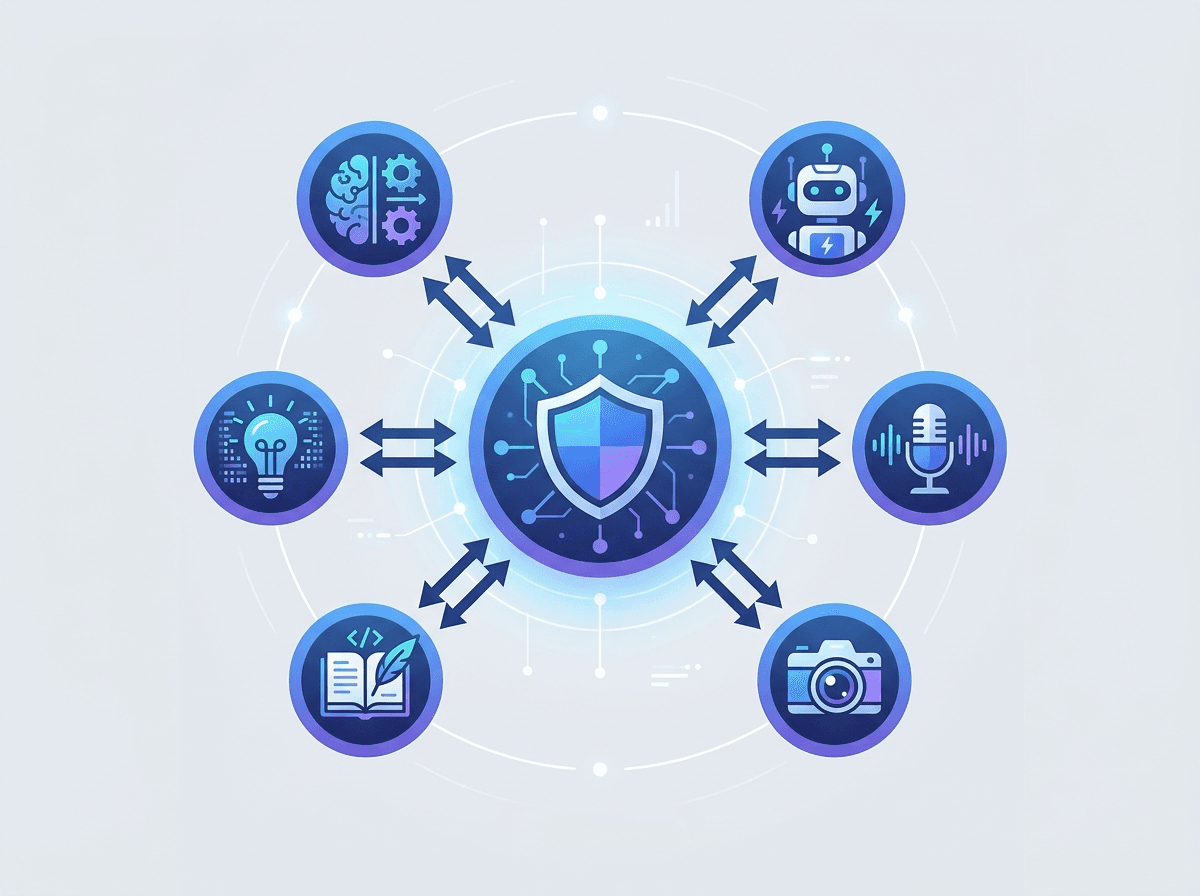
Amazon Bedrock is not simply a service for hosting AI models. It is an orchestration platform that enables enterprises to access a multitude of foundation models — whether from Anthropic, Mistral, Meta, or now OpenAI — via a unified, secure, and governable interface.
The integration of OpenAI's GPT models into Bedrock represents a symbolic and practical breakthrough. Until now, using GPT in enterprise meant going through the OpenAI API directly, with the constraints that entails: separate access management, OpenAI's own data policies, separate billing, and above all increased complexity for IT teams that had to maintain multiple integration pipelines.
With Bedrock, enterprises can now call GPT-6 using the same APIs they use for Anthropic's Claude or Meta's Llama: the Converse API, the Chat Completions API, or the Responses API. Concretely, this means:
- Centralized governance: usage logs, IAM access control, compliance audits in a single AWS environment.
- Increased application portability: switching foundation models becomes a configuration change, not a complete refactor.
- Reduced vendor lock-in risk: teams can test, compare, and switch between models without rewriting their applications.
For French enterprises already committed to an AWS cloud strategy, this is an opportunity to rationalize their AI stack while accessing the most performant models on the market.
Concrete Use Cases for French Enterprises

This convergence is not just a technical curiosity. It opens immediate operational perspectives for sectors that are very present in the French economy.
In financial services and insurance, teams can now orchestrate complex document analysis workflows — contracts, statements, compliance reports — by combining the power of GPT-6 for advanced contextual understanding with AWS's native security safeguards (encryption, VPC, IAM). An audit firm can, for example, automate the preliminary review of thousands of contractual documents while keeping data in a controlled environment.
In industry and manufacturing, enterprises can connect their ERP systems and technical knowledge bases to AI agents based on GPT-6, accessible via Bedrock, to assist maintenance technicians in real time. The response to a breakdown becomes contextual, based on machine history and technical manuals — all orchestrated within the enterprise's cloud environment.
In retail and e-commerce, large-scale personalization becomes more accessible. Data teams can deploy content generation pipelines, personalized recommendations, or augmented customer support, while benefiting from the flexibility of choosing the best model according to the use case — GPT-6 for rich text generation, a lighter model for classification tasks.
In the public sector and administrations, where data sovereignty is central, the ability to finely control where data transits and how access is logged via AWS represents a compelling argument for experimenting with generative AI in contexts previously blocked by regulatory constraints.
What This Evolution Means for Training Your Teams
Facilitated access to GPT models via Amazon Bedrock is good technical news. But it only translates into business value if teams are trained to leverage it in a structured manner.
The first competency to develop is literacy in APIs and multi-model architectures. Developers and architects must understand the differences between Converse, Chat Completions, and Responses APIs, know when to use one over another, and master the configuration of cross-region inference profiles. This is not a trivial competency: poor configuration can lead to excessive costs or latency issues.
The second key competency is governance and IAM permission management in a multi-model context. With multiple models accessible from the same platform, the temptation to simplify access rights is great — and dangerous. IT teams must be trained to apply the principle of least privilege to AI architectures that evolve rapidly.
Finally, and this is often the most overlooked point, business teams must be trained in designing relevant use cases and evaluating model outputs. Knowing that a GPT-6 model is available on Bedrock is not enough: you still need to know how to formulate the right prompts, interpret results with a critical eye, and integrate these tools into existing business processes without creating new friction.
At Ikasia, we support French enterprises throughout this skills development journey — from technical teams to decision-makers, including business functions. Our training programs are designed to be directly applicable, with exercises rooted in the reality of your sector.
Take the Next Step with Ikasia
The convergence of major AI ecosystems — OpenAI, AWS, and other actors tomorrow — is not a distant trend. It is becoming concrete today, and enterprises that can quickly train their teams will gain a decisive advantage.
Ikasia supports French organizations in their AI transformation: maturity audits, custom training, co-construction workshops for use cases, and deployment support. Whether you are at the beginning of your reflection or already engaged in AI projects, our experts are here to help you structure your approach and maximize your return on investment.
Contact us at ikasia.ai to discuss your challenges and discover how we can support you in this new era of AI in enterprise.
Tags
Related articles

OpenAI on Amazon Bedrock: What Asia-Pacific Availability Means for French Enterprises Going Global
Read
OpenAI Partner Network: $150 Million to Accelerate Enterprise AI Transformation — What Changes for You
Read
GPT-5.5 Instant: What OpenAI's New Model Concretely Changes for Your Teams and Processes
ReadWant to go further?
Ikasia offers AI training designed for professionals. From strategy to hands-on technical workshops.