AI Code Generation in Enterprise: How Amazon Bedrock Guardrails Protect Your Workflows Without Compromising Productivity
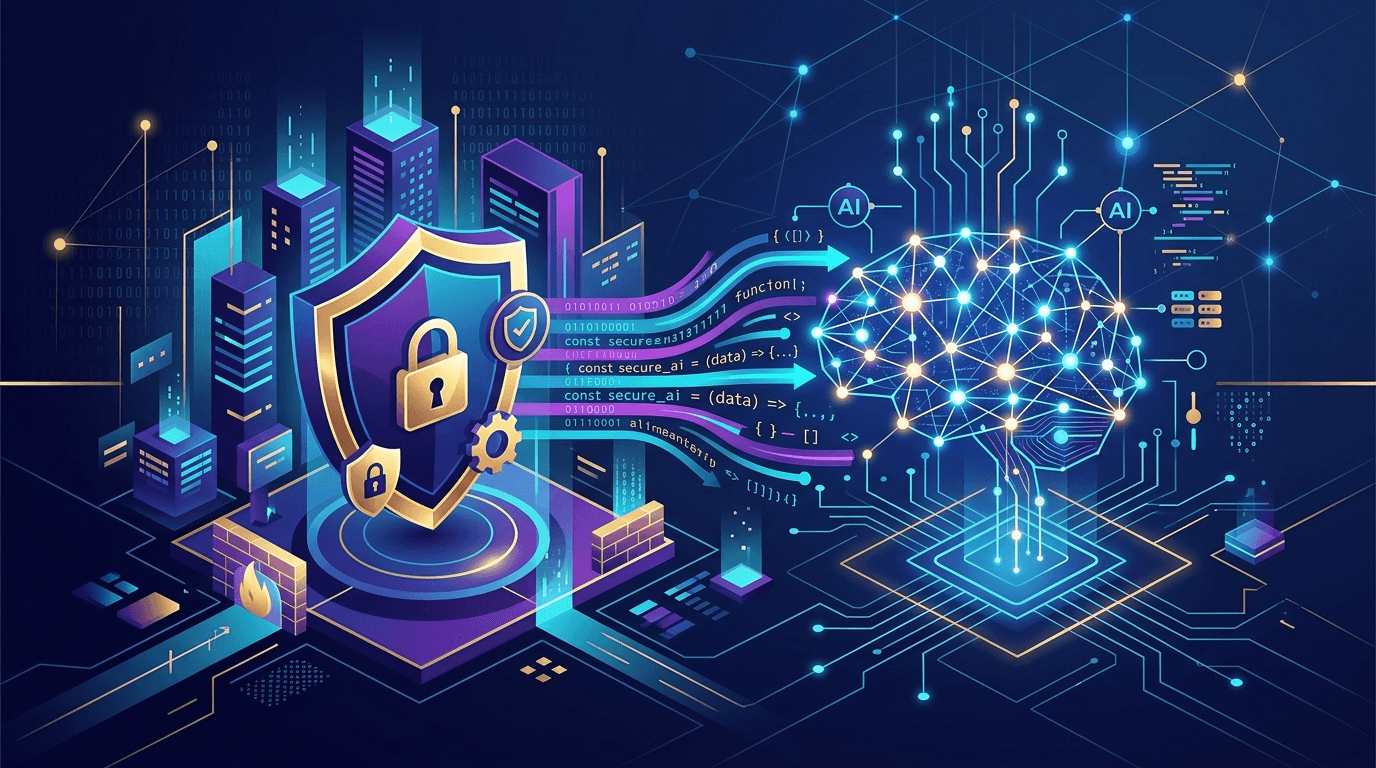
French enterprises are rapidly adopting AI-powered code generation assistants. From development teams at major banks to product teams at SaaS startups, generative AI has become an undeniable productivity lever. Yet this rapid adoption raises a strategic question too often sidelined: how can you ensure that generated code meets your security, compliance, and business alignment requirements? This is precisely the challenge Amazon Bedrock Guardrails addresses — with concrete implications for any organization deploying coding assistants in production.
Why AI Code Generation Without Guardrails Is a Real Business Risk
Contrary to common assumption, the risk associated with code generation assistants extends far beyond traditional software security vulnerabilities. It is far more systemic. An LLM (large language model) used without controls can produce code that:
- exposes sensitive information by embedding API keys, credentials, or personal data directly in source code;
- violates regulatory compliance rules, particularly in sectors subject to GDPR, the NIS2 directive, or ANSSI recommendations;
- generates unauthorized software dependencies, introducing third-party libraries not validated by your IT department;
- reproduces proprietary or restrictively licensed code, exposing your company to legal risks.
For French enterprises operating in regulated environments — finance, healthcare, defense, public sector — these risks are not theoretical. They have direct consequences for compliance, reputation, and business continuity. Ignoring the governance of generative AI applied to code means opening a breach in your overall security posture.
Amazon Bedrock Guardrails: A Control Architecture That Serves Performance
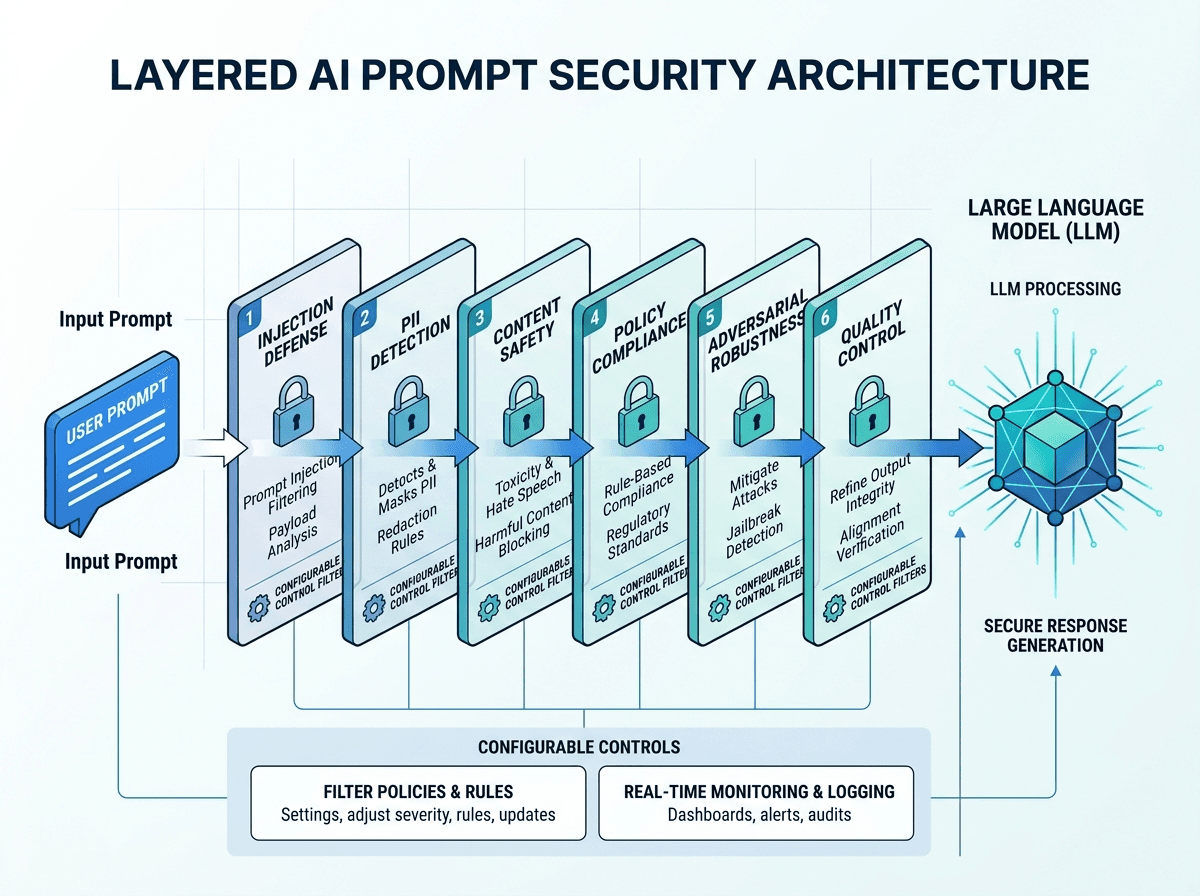
Amazon Bedrock Guardrails is a configurable control mechanism that sits between the user (the developer) and the language model. It is not simply a keyword filter, but a layer of contextual intelligence capable of evaluating inputs (prompts) and outputs (generated code) according to precise business rules.
Regarding code generation workflows, several key configurations prove particularly effective:
1. Filtering Sensitive Content in Prompts If a developer submits a prompt containing actual personal data to "test" a function, Bedrock Guardrails can detect and block this information before it reaches the model — protecting data confidentiality at the source.
2. Output Control via Topic Policies You can define forbidden domains: the model will not generate code related to certain critical operations (direct access to production databases, authentication bypass, etc.) even if explicitly requested in the prompt.
3. Detection of Identifying Information (PII/Secrets) Bedrock Guardrails integrates native detection of patterns corresponding to secrets (tokens, SSH keys, credit card numbers) in both the inputs and outputs of the model.
4. Grounding and Alignment with Your Internal Policies By combining Guardrails with RAG (Retrieval-Augmented Generation) on your internal documentation, you can guide the model toward your in-house coding standards — naming conventions, approved frameworks, architectural patterns validated by your team.
For an IT director, this architecture means one concrete thing: you can deploy a powerful code generation assistant while maintaining control over what it produces, without having to choose between innovation and security.
Real-World Applications for French Enterprises
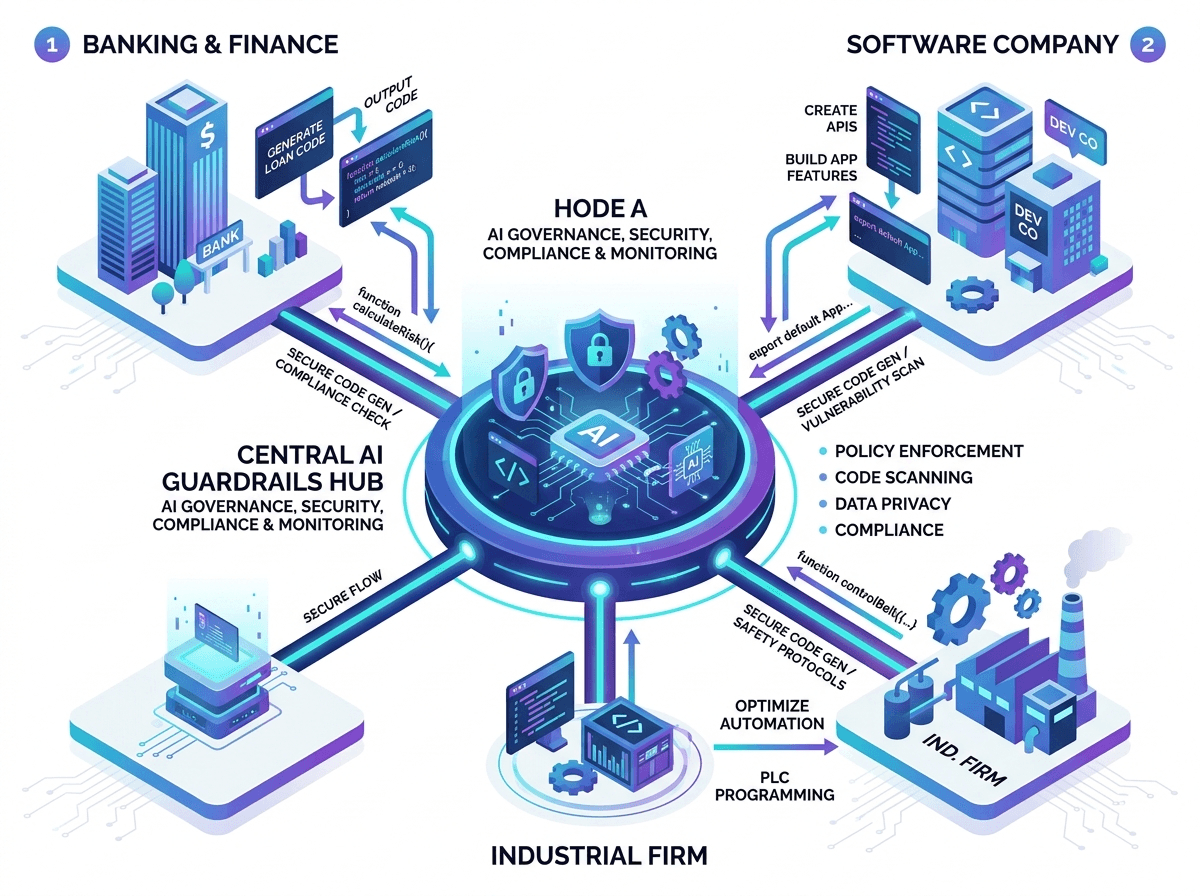
Imagine three scenarios representative of the French business landscape:
A regional bank deploys a code assistant for its backend teams. Thanks to Guardrails configured on sensitive topics, the assistant automatically refuses to generate code that could circumvent transaction audit mechanisms — a direct requirement of the ACPR (Autorité de Contrôle Prudentiel et de Résolution) recommendations.
A B2B SaaS software publisher wants to accelerate the generation of its unit tests. It configures Bedrock Guardrails to prohibit the use of real customer data in test fixtures and to enforce the use of approved mocking libraries. Result: tests generated 3x faster, compliant with security policies from the first iteration.
A mid-sized industrial company seeking to automate technical documentation of its legacy code. Guardrails are configured to prevent any leakage of sensitive intellectual property in prompts sent to the model, while guiding outputs toward a standardized ISO documentation format.
In each of these cases, the added value is not merely security-related — it is also operational: fewer code reviews for compliance reasons, fewer post-deployment incidents, and an AI governance framework that is documentable and auditable.
Training Your Teams: The Human Factor Behind Technical Configuration
Deploying Amazon Bedrock Guardrails effectively is not simply a one-time technical configuration exercise. It is a continuous process requiring cross-functional skill development throughout your organization.
Your developers must understand why certain prompts are refused, how to formulate requests in ways that respect defined policies, and how to interpret guardrails feedback. Your cloud architects must be able to properly size policies according to use cases — because an overly restrictive policy harms productivity, while an overly permissive policy negates the security benefit.
Your compliance and legal teams must be involved from the outset in defining business rules translated into Guardrails configurations. AI applied to code is not solely an IT department issue: it is a matter of enterprise governance.
At Ikasia, we support French enterprises in this dual dimension: strategic understanding of AI tools like Amazon Bedrock, and skill development for technical and non-technical teams to unlock their full potential safely. Our training programs combine theory, sector-specific case studies, and hands-on configuration workshops — so your organization is not just an AI user, but truly master of its governance.
Would you like to assess your organization's maturity regarding generative AI governance issues applied to software development? Discover our training programs and consulting services on ikasia.ai and let's discuss the guardrails that truly match your business needs.
Tags
Related articles

AI and Young Users: What OpenAI's Strategy for Teens Reveals About AI Governance in the Enterprise
Read
Advanced AI Standardization: What French Enterprises Must Anticipate Now
Read
ChatGPT Enterprise: OpenAI Finally Gives CIOs and CFOs the Tools to Master AI Spending
ReadWant to go further?
Ikasia offers AI training designed for professionals. From strategy to hands-on technical workshops.