Autonomous AI Agents in Production: Google Opens a New Era for Enterprises with Gemini API
Agentic AI Finally Reaches Industrial Scale
For a long time, deploying AI agents in production was a challenging journey for technical teams. Between error management, tool call reliability, and the complexity of multi-step orchestrations, the promises of agentic AI clashed with frustrating operational realities. Google has just changed the game with a major update to its Managed Agents in the Gemini API: background tasks, remote MCP protocol support, and a series of improvements designed for real production environments.
For French enterprises — ambitious SMEs, mid-market companies undergoing digital transformation, or large corporations seeking to industrialize their AI use — this announcement deserves particular attention. It marks a turning point: we're no longer talking about demonstrations or proofs of concept, but about agents capable of operating autonomously in complex business environments, with the robustness required for daily use.
What Google's Managed Agents Actually Change
Google's announced innovations revolve around three major axes that transform what's possible with AI agents in a professional context.
Background tasks are arguably the most structuring advancement. Until now, an agent had to maintain an active connection to accomplish a long-running task — which posed obvious issues with timeouts, costs, and reliability. Now, it's possible to launch an agent on a complex task (analyzing a document corpus, consolidating multi-source data, drafting a structured report) and retrieve the result once the work is complete, without continuous monitoring. For a finance department launching an automated analysis of its dashboards each morning, this is a paradigm shift.
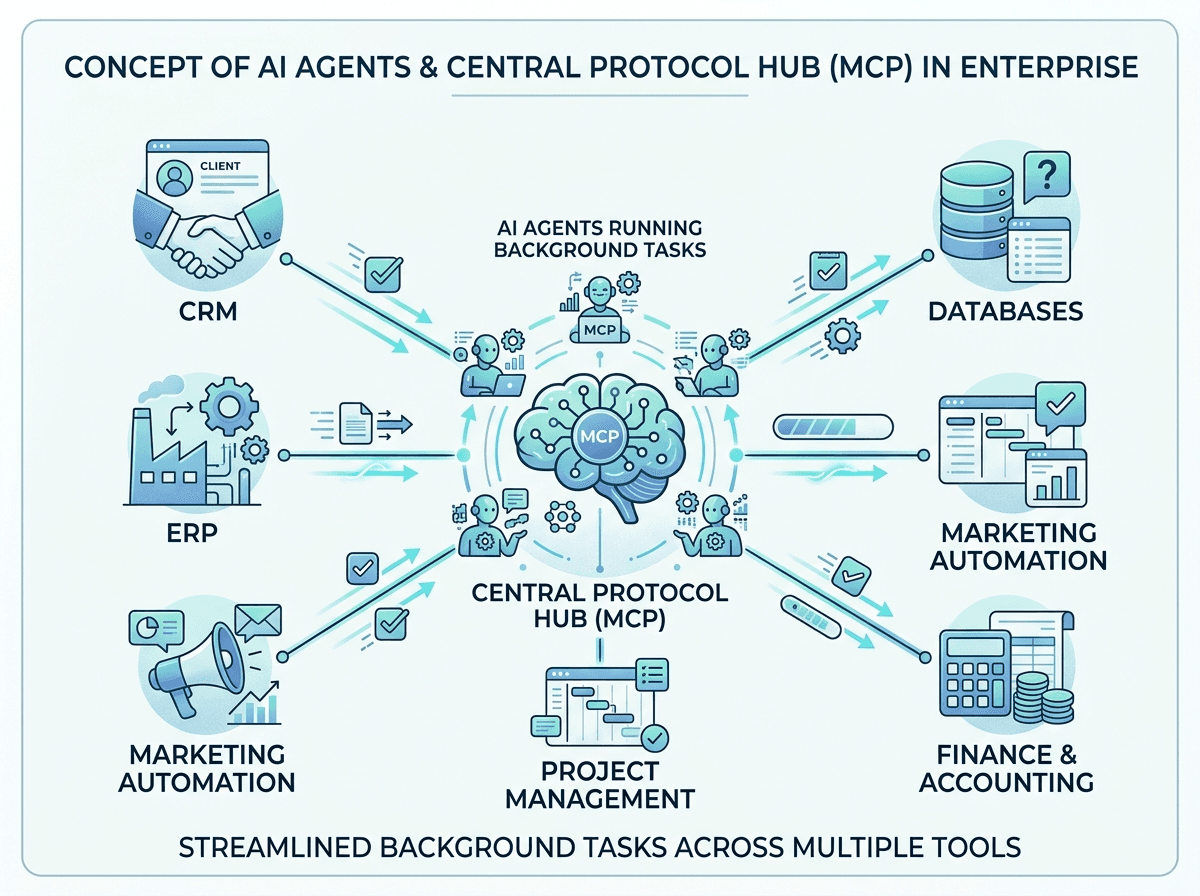
Support for the remote MCP protocol (Model Context Protocol) is another decisive piece. MCP is becoming the standard for interoperability between AI agents and external tools — somewhat like what REST is for web APIs. By allowing Gemini agents to connect to remote MCP servers, Google opens the door to architectures where your agents can natively interact with your business tools: CRM, ERP, internal databases, SaaS platforms. Gone are the days of ad-hoc and fragile integrations.
Improved reliability and state management complete the picture. Agents can now resume an interrupted task, handle complex conditional flows, and precisely trace each step of their reasoning — which is essential when addressing auditability and compliance questions, particularly sensitive in the European regulatory context.
Concrete Use Cases for French Enterprises
These technical capabilities are only interesting if they translate into tangible business value. Here's how French enterprises can leverage them right now.
In the legal and compliance sector, a law firm or corporate legal department can deploy an agent that continuously monitors regulatory flows (Official Journal of the EU, CNIL, AMF), analyzes new texts in the background, and generates a personalized digest each morning with potential impacts on ongoing contracts. What took several hours of manual monitoring becomes an automated and traceable process.
In supply chain and logistics, an agent connected via MCP to the ERP, supplier data, and sales forecasts can proactively identify rupture risks, propose sourced alternatives, and even initiate quote requests — all without human intervention for standard cases, and with escalation to a buyer for complex situations.
In human resources, imagine an agent that processes all applications received for a position in the background, compares them against criteria defined by the recruiter, enriches each profile with relevant public data, and delivers a commented and argued shortlist. The recruiter takes over the final decision, but their time is freed up for what really matters: the human interview.
In marketing and customer relations, an agent can analyze customer verbatims from multiple channels each night (emails, online reviews, support tickets), identify emerging trends, and automatically feed the CRM with actionable insights — connected directly via MCP to tools like Salesforce or HubSpot.
Training Your Teams for the Era of Autonomous Agents
Deploying reliable AI agents in production doesn't happen by chance. While technology is making a decisive leap with these announcements, the human factor remains crucial to project success.
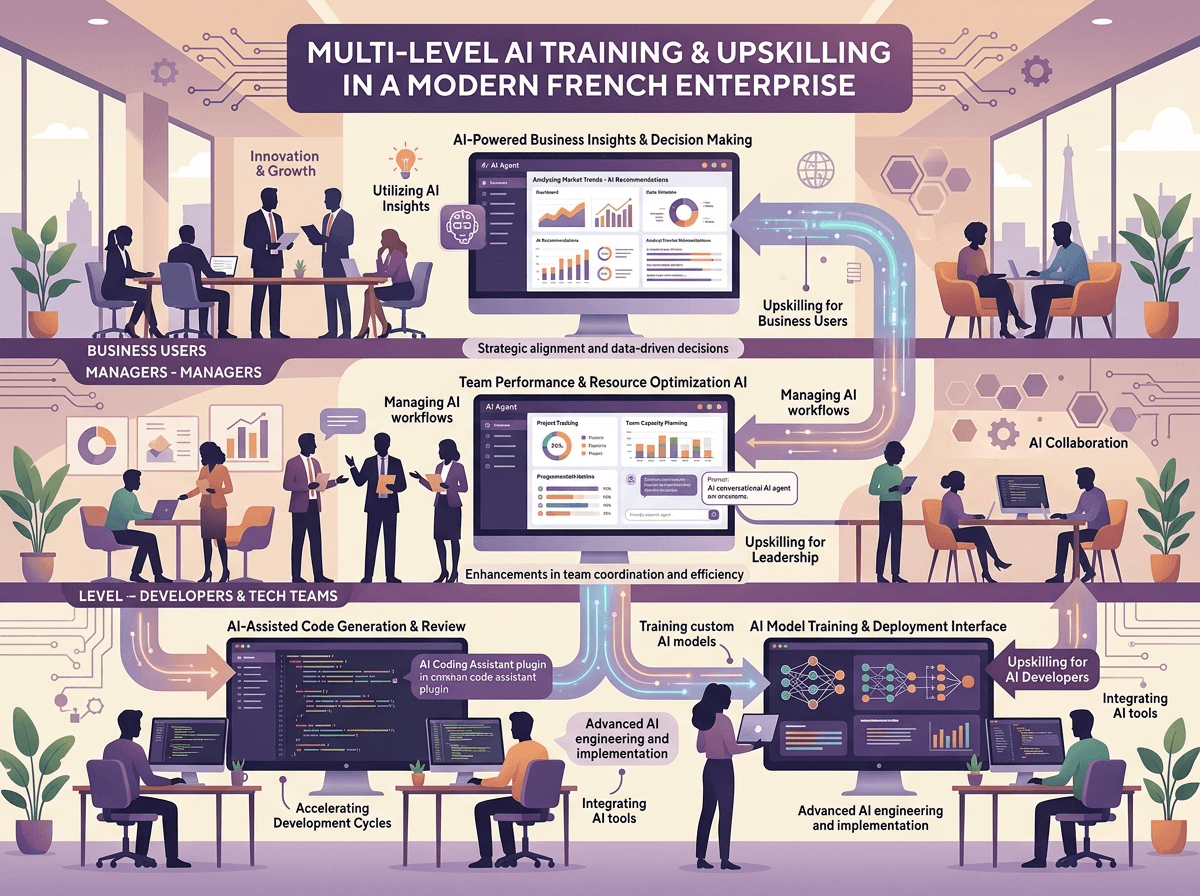
Teams need to develop several levels of competency. Developers and architects must master the new paradigms of agentic AI: designing multi-step workflows, managing state, MCP integration, monitoring, and observability of agents. These are skills that diverge from classical development and require specific training.
Business teams and project managers must learn to think in terms of automatable processes, define appropriate guardrails for agents, and design human oversight loops suited to each context. An agent that's too autonomous in a poorly-defined process can create as many problems as it solves.
Finally, managers and executives need a clear strategic perspective: which processes are mature for agentic automation? What regulatory risks should be anticipated — particularly regarding the European AI regulation? How to measure the real ROI of these deployments?
At Ikasia, we support precisely these three levels, with training and consulting missions adapted to the realities of French enterprises. Our programs integrate the latest technological developments — including these new Gemini capabilities — so your teams are operational, not just informed.
Take Action Before Your Competitors
Enterprises that deploy reliable AI agents in production over the next 12 months will gain a difficult-to-close advantage. Google has just removed one of the main technical obstacles to this industrialization. The question is no longer "does it work?" but "where do we start and how do we avoid mistakes?".
Ikasia supports French enterprises of all sizes in this transition — from AI maturity audits to deploying first agents in production, including team skills development.
Schedule a meeting with our experts on ikasia.ai for a free diagnostic of your AI agent opportunities. Together, let's identify the two or three processes where you could deploy a reliable agent in the coming months — and build the roadmap to get there.
Tags
Related articles

Want to go further?
Ikasia offers AI training designed for professionals. From strategy to hands-on technical workshops.