Agentic AI and Scientific Computing: What Laboratories Are Teaching French Companies
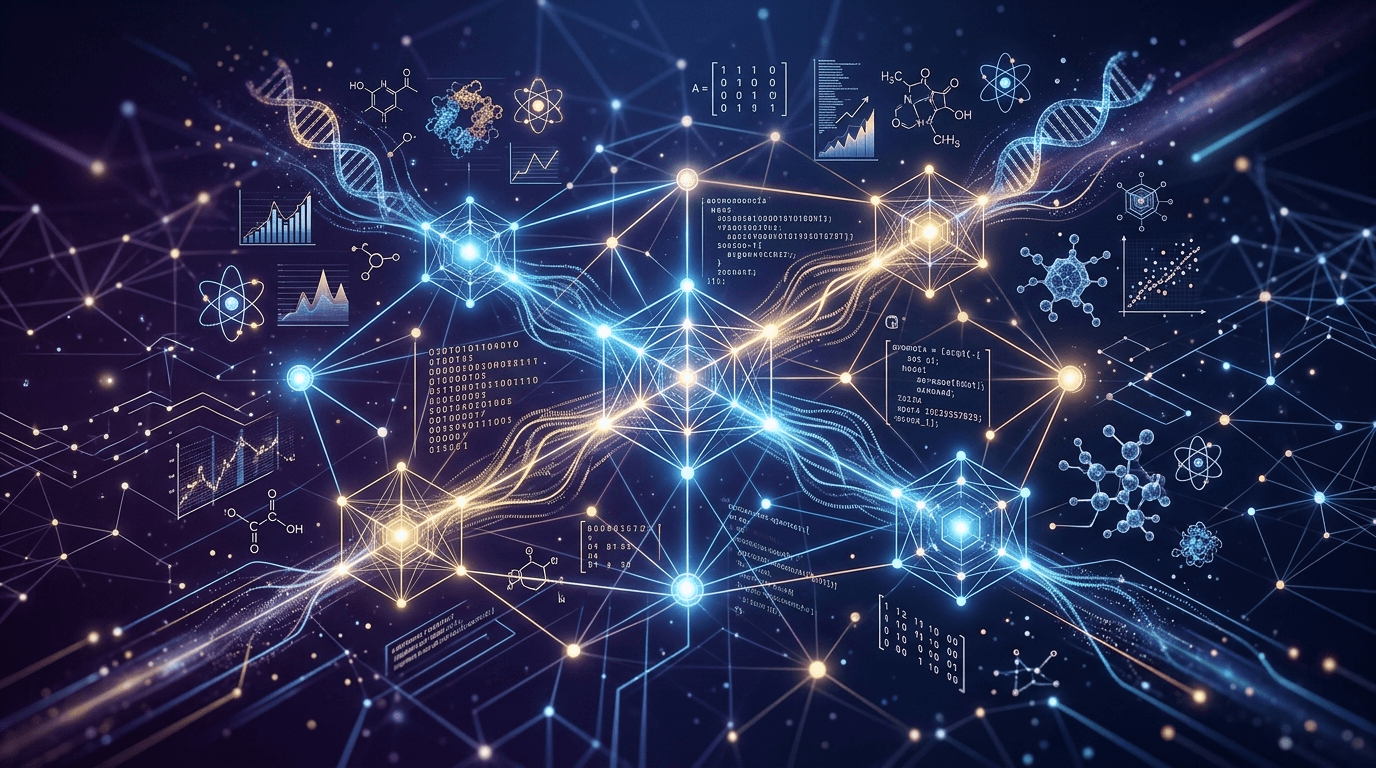
The boundary between cutting-edge scientific research and the corporate world has never been more porous. A report published by OpenAI reveals how scientists are now using autonomous AI agents to modernize scientific computing — accelerating software development and discovery in strategically important fields like genomics. For French companies, this weak signal is actually a strong one: agentic AI is no longer confined to research laboratories. It's knocking on the door of your R&D, IT and data departments.
Agentic AI: From Genomics to Your Next Corporate Project
Unlike conventional AI tools that respond to a single question, an AI agent is capable of chaining complex tasks autonomously: analyzing an environment, planning steps, executing code, correcting its errors and delivering a result. In the field of scientific computing, this translates to researchers entrusting these agents with rewriting codebases decades old, optimizing algorithms or automating exploration of massive genomic data.
The parallel with the corporate world is immediate. Think of your own "technical debt": unmaintained legacy software, analysis scripts scattered across teams, manual reporting processes that keep engineers busy for hours. AI coding agents — like those built around GPT-4o or Claude models — can now take on these projects with minimal human supervision.
A French industrial SME in the pharmaceutical sector, for example, could entrust an AI agent with modernizing its molecular simulation scripts, reducing weeks of developer work to a few days. A renewable energy engineering firm could automate analysis of its sensor data, moving from weekly batch processing to near real-time analysis.
Three Concrete Use Cases for French Companies
The lesson from the OpenAI report is clear: agentic AI generates value where data is voluminous, processes are repetitive, and technical expertise is scarce. Here are three domains where French companies can take action now.
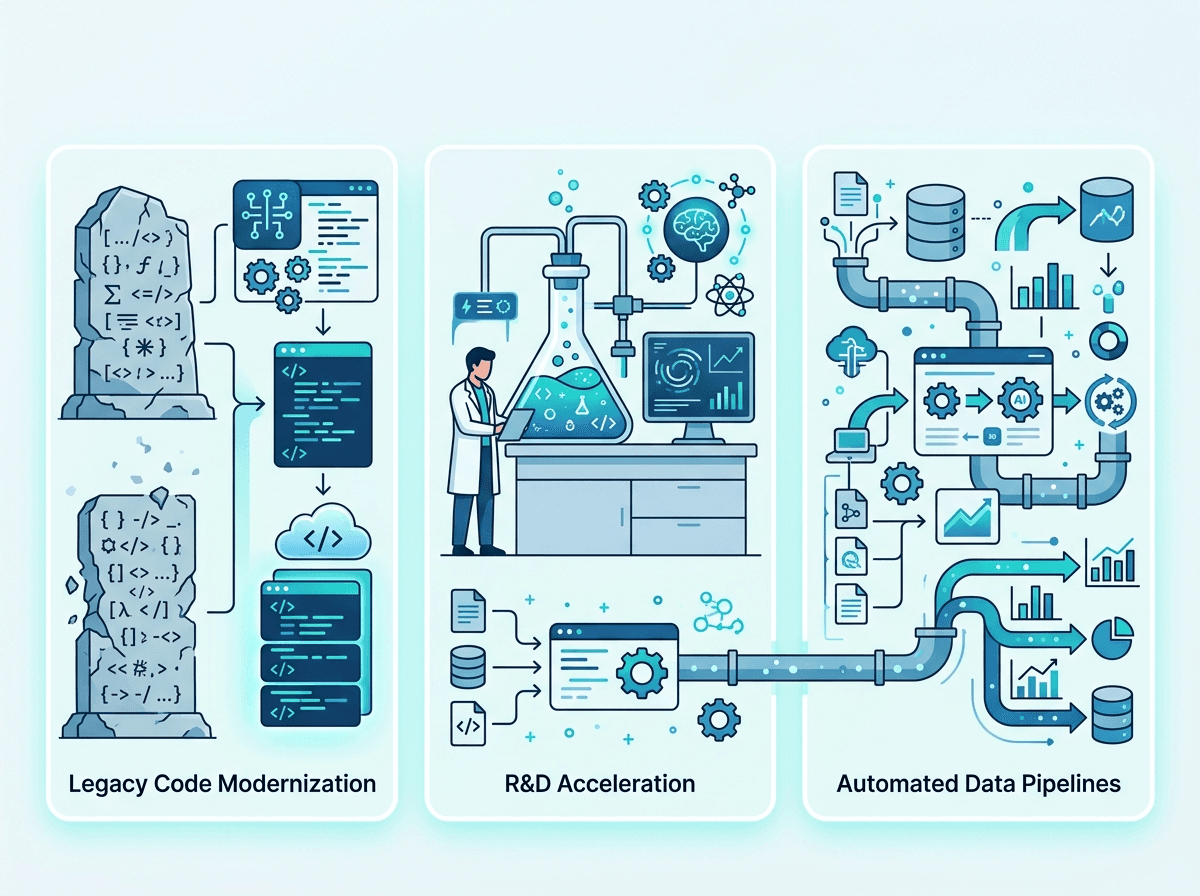
1. Modernization of Legacy Codebases Many French industrial and financial companies still rely on FORTRAN, COBOL or undocumented Python scripts. AI agents can analyze these bases, propose refactorings, generate unit tests and document code automatically — drastically reducing risk during migrations.
2. Accelerating R&D and Testing In fine chemicals, food and agribusiness or advanced materials sectors, agents can automate computational experimentation cycles: launching simulations, interpreting results, adjusting parameters and relaunching — all in a closed loop. What OpenAI researchers observe in genomics applies equally to a cosmetics laboratory in Grasse or an automotive R&D center in Île-de-France.
3. Automation of Data Pipelines and Reporting Data engineering teams still spend considerable time maintaining fragile pipelines. AI agents can monitor these pipelines, detect anomalies, correct data errors and generate synthetic reports — freeing human talent for higher-value tasks.
Conditions for Success: Governance, Trust and Human Supervision
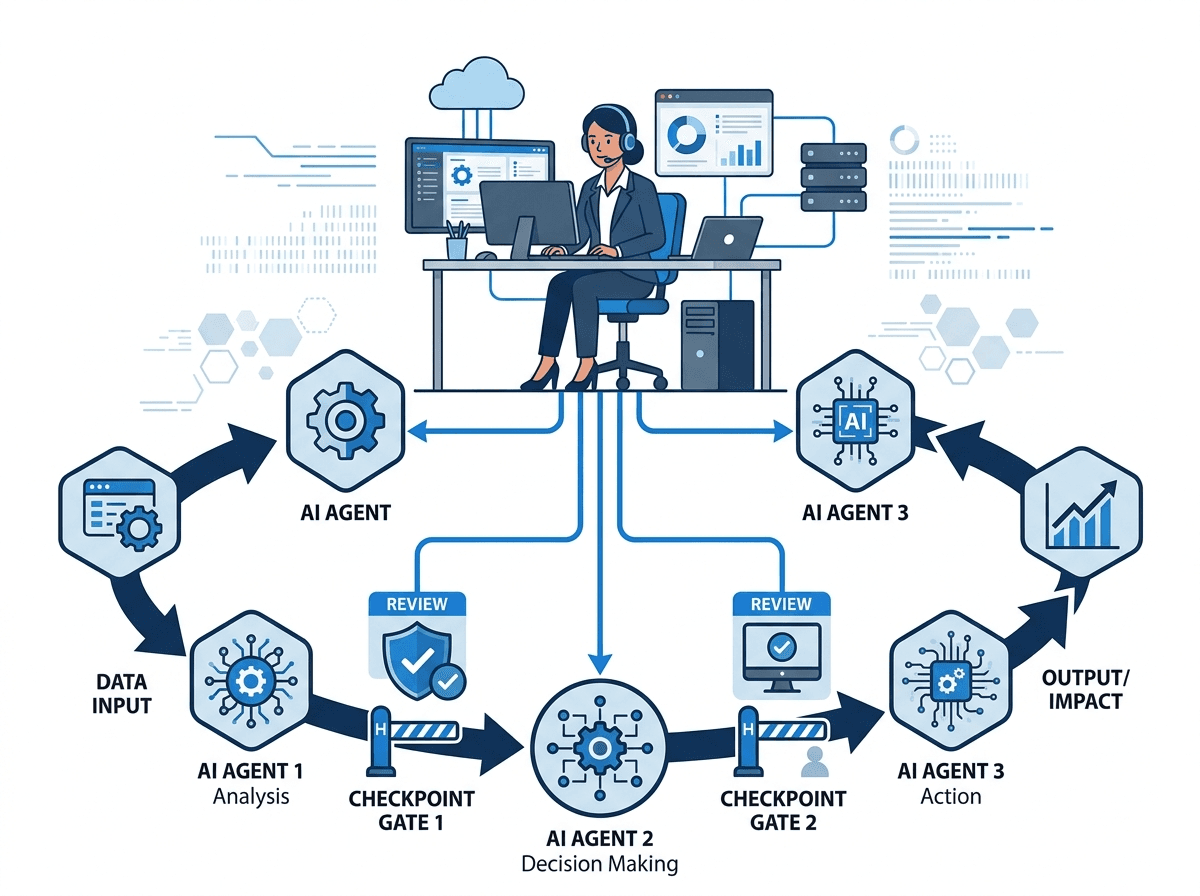
Enthusiasm for agentic AI must be accompanied by rigorous thinking about governance. The scientists cited in the OpenAI report don't let agents run unchecked: they define clear objectives, bounded scopes of action and regular human control points. This model precisely — humans in the loop — should guide French companies in their deployments.
Several challenges need to be anticipated:
- Data security: agents executing code must operate in sandboxed environments, compliant with GDPR and internal security policies.
- Decision traceability: every agent action must be logged to enable audit and correction.
- Cascade error management: an autonomous agent can amplify an initial error. Human validation mechanisms at key stages are essential.
- Alignment with business objectives: an agent that is technically efficient but poorly framed can optimize the wrong metric. Defining objectives remains a non-negotiable human responsibility.
Companies that will succeed in their transition to agentic AI won't be those that automate fastest, but those that build robust supervision processes and a culture of progressive trust toward these systems.
Training Your Teams in the Age of AI Agents: A Strategic Investment
The most profound change induced by agentic AI is not technological — it's human. Your colleagues need to learn to work with agents, not just with tools. This implies new skills:
- Advanced prompt engineering: knowing how to formulate complex objectives, decompose tasks and define constraints to guide an agent.
- Critical evaluation of outputs: developing the reflex to verify, identify hallucinations or logical errors in generated code.
- Multi-agent orchestration: understanding how to make multiple specialized agents collaborate on the same project.
- AI ethics and responsibility: integrating issues of bias, transparency and regulatory compliance into every deployment.
These skills don't come by improvisation. They're acquired through structured, progressive training rooted in the business realities of each sector. Technical teams aren't the only ones concerned: managers, project leads and support functions must also understand the capabilities and limitations of these new digital collaborators.
The age of agentic AI is here, and it's reshaping the contours of industrial and scientific competitiveness. French companies that can adopt it intelligently — with the right governance, right use cases and right skills — will gain decisive competitive advantage.
Ikasia supports French companies through this transition, from strategic awareness to operational training of your teams. Whether you want to understand how AI agents can integrate into your existing processes, or train your collaborators in new practices of AI-augmented development, our experts are by your side.
👉 Discover our training and consulting programs at ikasia.ai — and move from experimentation to real transformation.
Tags
Related articles
The Era of AI Agents: How to Drive Your Investments for Measurable ROI
Read
AI and Regulatory Filing: How Artificial Intelligence Cuts Compliance Document Drafting Time by 15%
Read
From Weeks to Hours: How Agentic AI Transforms Software Delivery at Endava (And What French CIOs Must Learn)
ReadWant to go further?
Ikasia offers AI training designed for professionals. From strategy to hands-on technical workshops.