The Era of AI Agents: How to Drive Your Investments for Measurable ROI

Artificial intelligence is entering a new phase of maturity. After the excitement surrounding chatbots and generative tools, companies now face a more strategic question: how can we ensure that every euro invested in AI actually delivers real value? OpenAI has just published a thinking framework for business leaders confronting this challenge in what's called the "agentic era" — where AI systems no longer merely respond, but act autonomously on complex processes. For French companies, often cautious about technology investments and subject to specific regulatory constraints (GDPR, European AI Act), this approach comes at precisely the right moment.
From Generative AI to Agentic AI: A Paradigm Shift for Leadership
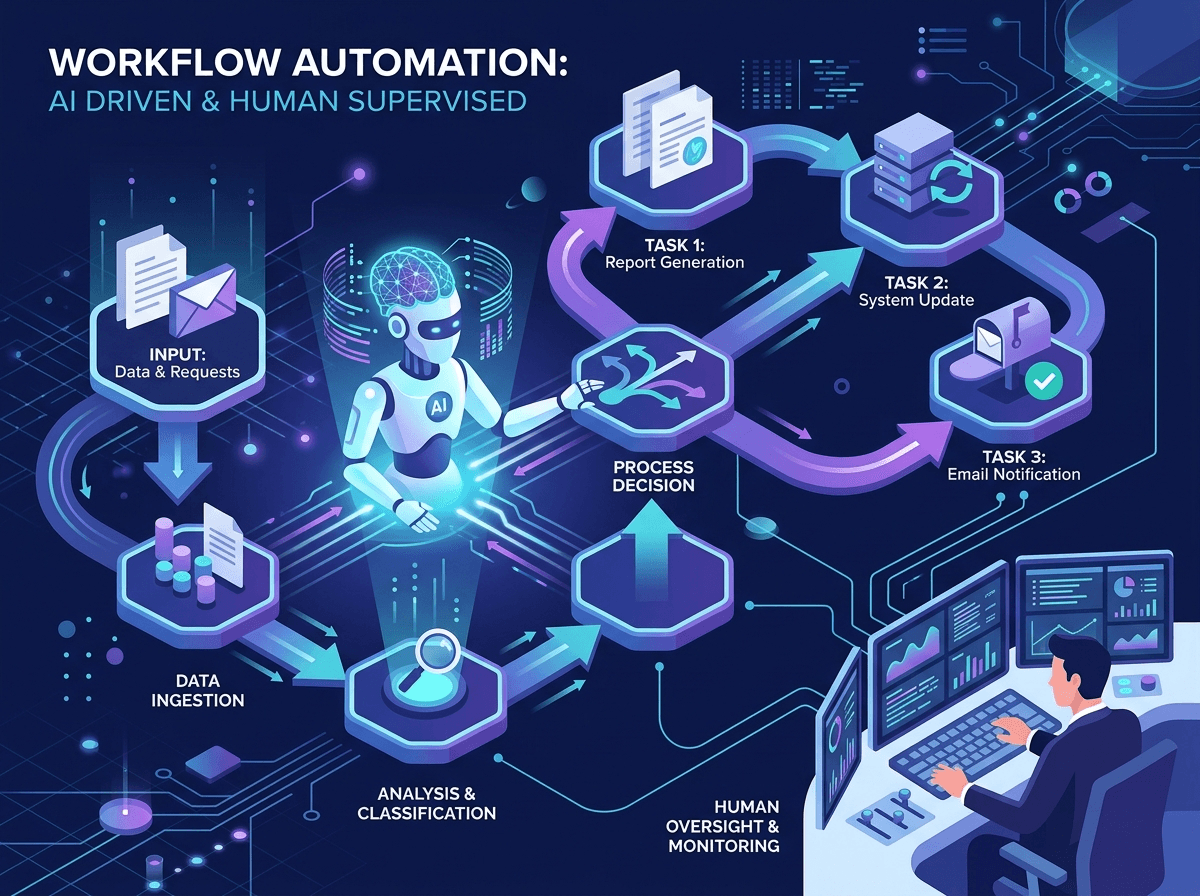
Agentic AI represents a major qualitative leap. Where a tool like ChatGPT responds to a single query, an AI agent orchestrates sequences of actions: it consults databases, drafts documents, sends notifications, updates CRM systems, and makes intermediate decisions — all without constant human intervention.
Concretely, imagine an agent deployed in a procurement department of an industrial group based in Lyon: it monitors commodity price fluctuations in real time, automatically compares supplier offers, generates purchase proposals, and alerts the manager only in case of anomalies. What once required two full-time employees can now be managed by an agent with lighter human supervision.
But this potential gain raises a crucial governance question: how do we evaluate whether this agent is "performing well" for the company? This is precisely the heart of the framework OpenAI proposes.
Measuring Real Value: The "Useful Work Per Dollar Invested" Concept
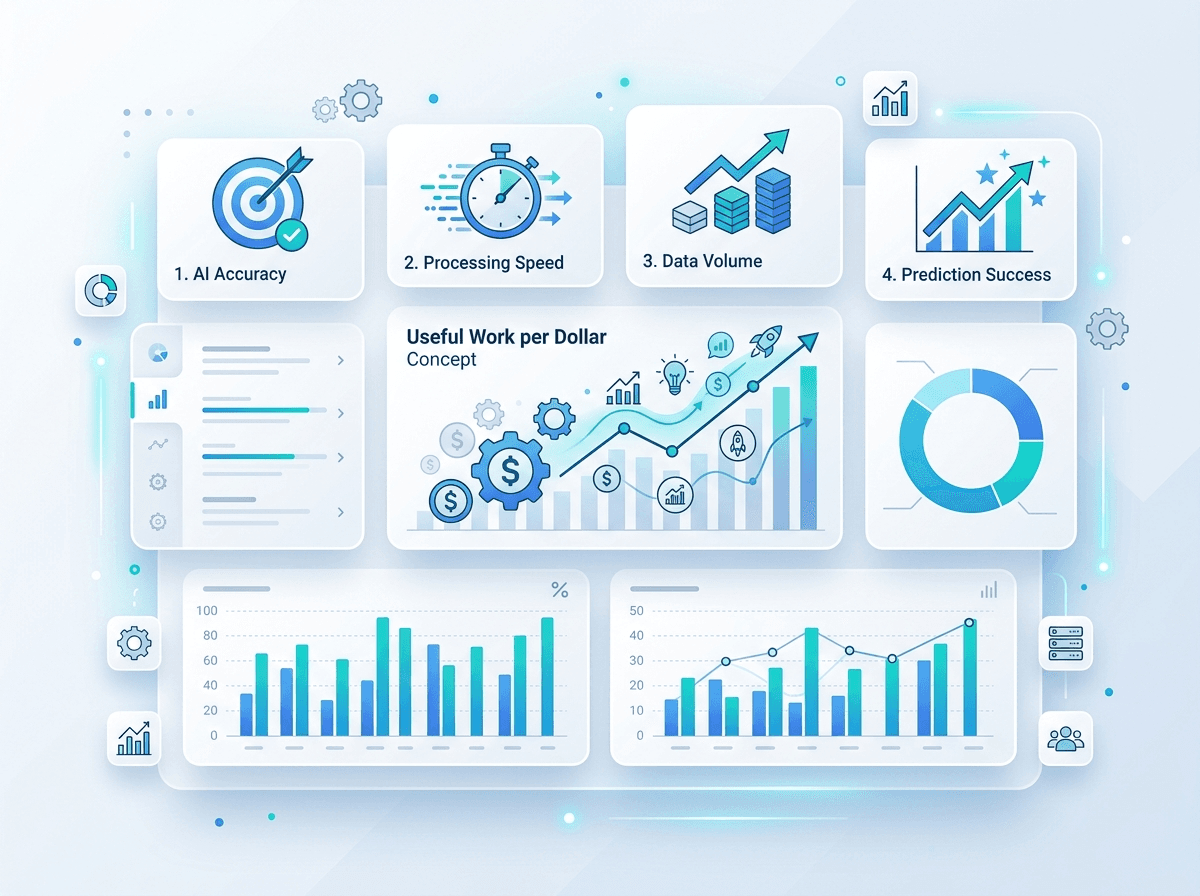
The main insight from the OpenAI framework is introducing a clear performance metric: useful work produced per dollar spent. This approach breaks with the typical tendency to measure AI through usage indicators (number of requests, adoption rate) rather than its actual business impact.
For French CIOs and CFOs, this means rethinking their AI project dashboards around three axes:
- Efficiency: what operational cost is avoided or reduced thanks to the agent? (FTE hours saved, cost per file processed, reduced cycle time)
- Effectiveness: is the quality of work produced at the expected level? (error rate, customer satisfaction, compliance)
- Scalability: can the system handle increased volume without prohibitive marginal costs?
Take the example of a Parisian law firm that deployed an agent to review contracts. The right question isn't "how many contracts did the agent analyze?" but rather "what is the review cost per contract with the agent versus without, and is legal quality preserved?". Only then is the investment justifiable to the executive committee.
Identifying and Prioritizing High-Value Workflows
Not all business processes lend themselves equally well to agentic automation. OpenAI recommends a workflow mapping approach based on two criteria: task repeatability and its impact on created or preserved value.
Priority opportunity areas for French companies typically include:
- High-volume document support functions: accounts payable, expense management, HR onboarding, regulatory compliance
- Commercial functions: lead qualification, personalized proposal generation, automated post-sale follow-up
- Industrial operations: predictive maintenance, assisted quality control, logistics optimization
- Customer service: handling tier 1 and 2 requests, intelligent escalation to human advisors
For example, an SME specializing in food distribution in the Auvergne-Rhône-Alpes region was able to reduce B2B order processing time by 40% by deploying an agent capable of reading PDF purchase orders, reconciling them with available inventory, and automatically generating acknowledgments — freeing its order management teams for higher-value customer interaction tasks.
The key lies in not trying to automate everything at once, but in identifying the two or three workflows where impact will be most visible and fastest to measure.
Training Teams: The Human Factor Remains Decisive
One finding emerges forcefully from feedback from companies that have deployed AI agents: technology is never the main obstacle. It's the teams' ability to work with these new tools, supervise them intelligently, and evolve them that determines success.
In the agentic era, required skills shift significantly:
- Operational managers must learn to design workflows delegable to an agent (process prompt engineering, definition of human decision thresholds)
- IT and data teams must master agent orchestration, access management, and traceability of automated actions
- Compliance and legal functions must integrate the AI Act's new obligations for supervising high-risk automated systems
- Top management must be able to read and interpret new AI performance dashboards to make informed investment decisions
This need for skills development is structural, not temporary. It's not a two-day ChatGPT training, but a program for transforming professional practices rooted in the business realities of each sector.
Is your company ready to manage its AI investments with rigor?
At Ikasia, we support leaders and their teams in defining their AI strategy, selecting priority use cases, and training employees in agentic AI practices. Our programs combine technological expertise with deep understanding of French business challenges.
Contact us at ikasia.ai for a free AI maturity assessment tailored to your sector.
Tags
Related courses
Related articles

Agentic AI and Scientific Computing: What Laboratories Are Teaching French Companies
Read
AI and Regulatory Filing: How Artificial Intelligence Cuts Compliance Document Drafting Time by 15%
Read
How Jump Trading Revolutionizes Quantitative Research with AI: Lessons for French Businesses
ReadWant to go further?
Ikasia offers AI training designed for professionals. From strategy to hands-on technical workshops.