GPT-5.6 on Amazon Bedrock: How Prompt Caching Reduces Your AI Costs by 80% and Transforms Enterprise Workflows

Managing the costs of generative AI has become a strategic priority for CIOs and CFOs at French enterprises. As experiments multiply and large-scale deployments become commonplace, inference bills can quickly become a barrier to adoption. It is precisely in this context that Amazon Web Services has announced the general availability of OpenAI GPT-5.6 models — Sol, Terra, and Luna — on Amazon Bedrock, along with a feature with significant business impact: explicit prompt caching. An advancement that deserves the full attention of French decision-makers and technical teams.
GPT-5.6 on Amazon Bedrock: What Actually Changes for French Enterprises
Amazon Bedrock is AWS's managed platform that allows access to leading foundation models without having to manage the underlying infrastructure. Until now, French enterprises wanting to leverage OpenAI models had to go exclusively through OpenAI's API, with associated constraints: data sovereignty, GDPR compliance, and integration into an already established AWS ecosystem.
The arrival of GPT-5.6 Sol, Terra, and Luna on Bedrock opens a new path. These three variants of the GPT-5.6 model address differentiated needs:
- Sol is optimized for speed and low-latency use cases (chatbots, real-time assistants)
- Terra offers an ideal performance/cost balance for batch processing and document analysis
- Luna is positioned for complex tasks requiring advanced reasoning (legal analysis, due diligence, R&D)
For enterprises already operating in the AWS ecosystem — and there are many in France — this native integration significantly simplifies governance: unified billing, access management via IAM, centralized logs in CloudWatch, and compliance with already-obtained AWS certifications (HDS, ISO 27001, etc.).
Explicit Prompt Caching: The Feature That Changes the Financial Game
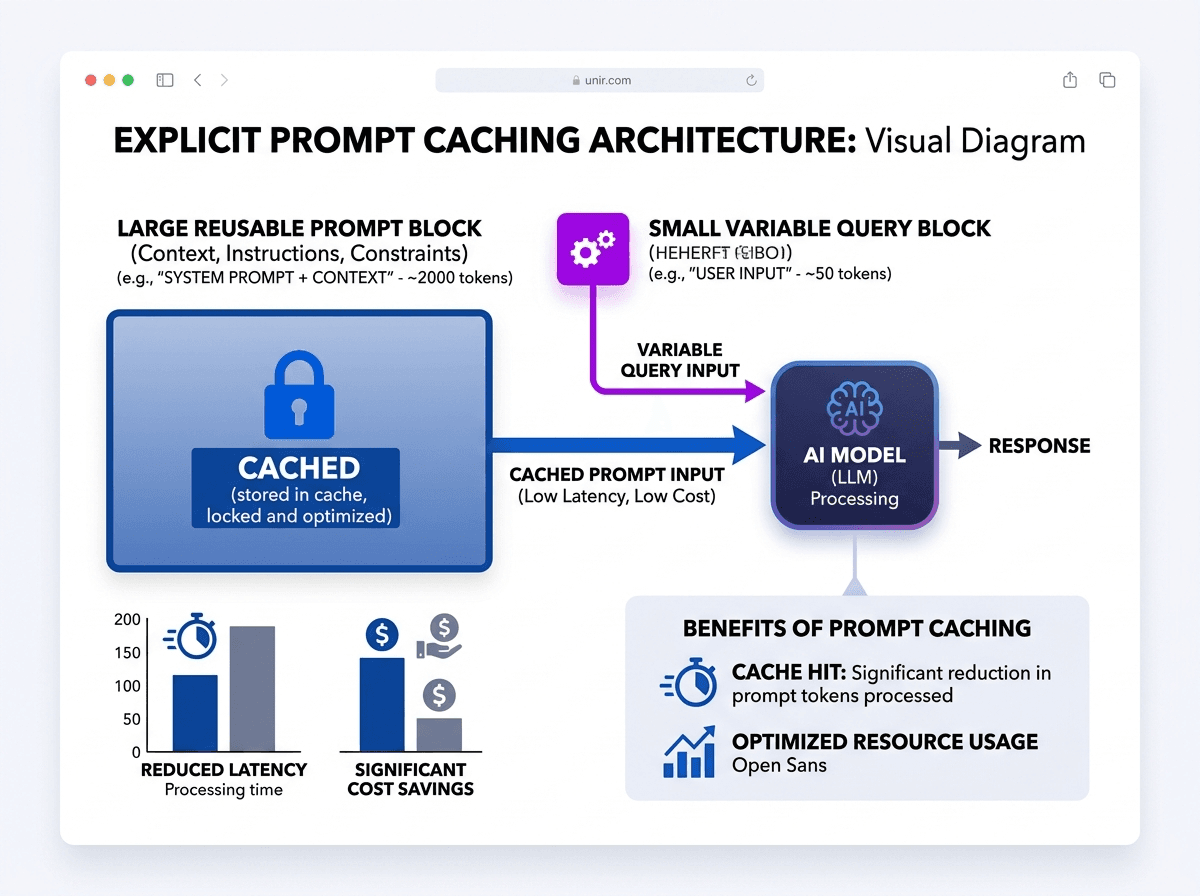
The real revolution announced is not merely the availability of the models, but explicit prompt caching. To understand its impact, you must first grasp how LLM billing works: each model call is charged based on the number of input tokens (prompt) and output tokens (response). Yet in most business applications, a large portion of the prompt is identical from one call to the next.
Let's take a concrete example: a Paris law firm using AI to analyze contracts. Each request includes a system prompt of 2,000 tokens describing instructions, legal context, and formatting rules — followed by 500 tokens specific to the contract being analyzed. Without caching, these 2,000 tokens are charged on every call. With explicit prompt caching, they are only charged once per cache window.
The difference from implicit caching (already existing with some providers) is fundamental: here, you decide exactly which portions of the prompt are cached. This granularity offers complete control over cost optimization and enables designing much more sophisticated architectures. Announced savings can reach 80% on input tokens for workloads with large reused system prompts — which corresponds to the majority of enterprise applications.
Concrete Use Cases for French Sectors
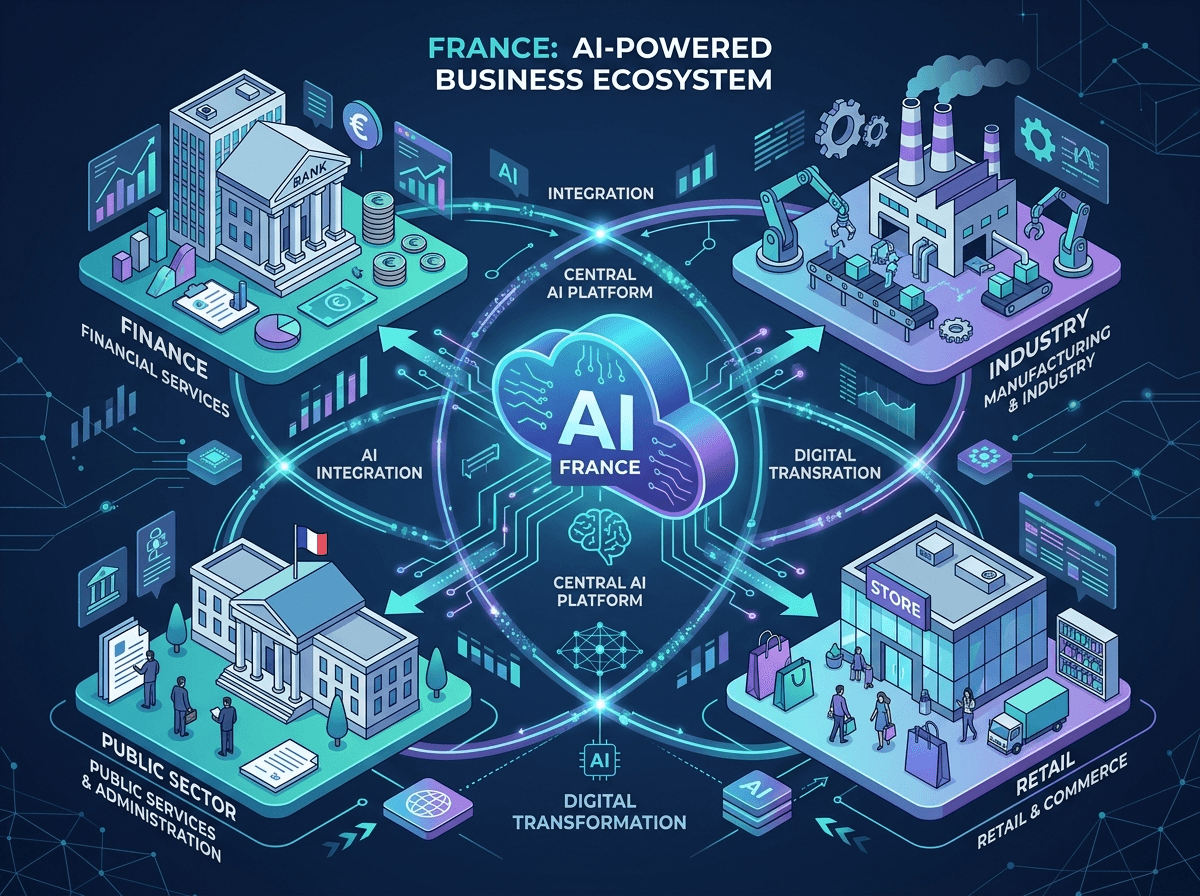
This combination — GPT-5.6 models + explicit caching on Bedrock — opens immediate perspectives for several key sectors of the French economy:
Financial Services and Banking: Institutions processing thousands of credit applications or analyzing bank statements systematically share a long system prompt (regulatory criteria, scoring instructions, AMF/ACPR compliance rules). Caching makes these large-scale analyses economically viable at scale.
Manufacturing and Industry: An automotive manufacturer or aerospace equipment supplier querying technical databases and maintenance manuals can pre-cache the entire documentary context. Result: technicians get near-instant answers to complex questions, and cost per request plummets.
Retail and Distribution: Retailers with large product catalogs can cache their complete catalog description, leaving customer questions as the only variable part of the prompt. Customer support chatbots thus become profitable even for small transaction volumes.
Public Sector and System Integrators: Business software publishers (ERP, HRIS, ECM) integrating AI into their solutions can build premium features with a controlled economic model, passing cost savings on to their own customers.
In all these cases, migration from existing GPT workloads is facilitated by the API compatibility announced by AWS, enabling gradual transition without complete code rewriting.
Training Your Teams to Capitalize on This Evolution
Having the best tools is not enough if teams don't know how to leverage them strategically. The introduction of explicit prompt caching perfectly illustrates this point: without a deep understanding of how LLMs work (tokenization, prompt structure, context windows), it is impossible to design an architecture that fully benefits from it.
The competencies to prioritize developing within technical and product teams include:
- Advanced prompt engineering: knowing how to structure a prompt to maximize reusability of cached portions
- Cost-aware AI architecture: integrating cost constraints from the design of inference pipelines
- Data governance on AWS Bedrock: mastering compliance tools, logging, and access control
- Model evaluation and benchmarking: comparing Sol, Terra, and Luna on real business use cases to choose the right model for context
These competencies are currently rare in the French market, creating a significant competitive advantage for organizations that invest now in upskilling their teams. Teams trained correctly don't merely use AI: they become capable of designing robust, economically optimized solutions aligned with their enterprise's specific business challenges.
Is your organization ready to benefit from GPT-5.6 on Amazon Bedrock? At Ikasia, we support French enterprises in their AI transformation: from training your technical teams to deploying custom solutions, including auditing your existing architectures. Our experts help you identify concrete optimization opportunities — like prompt caching — and build an AI roadmap coherent with your business objectives.
👉 Discover our training programs and consulting offerings at ikasia.ai and turn every euro invested in AI into a real performance lever.
Tags
Related courses
Related articles

OpenAI on Amazon Bedrock: What Asia-Pacific Availability Means for French Enterprises Going Global
Read
Claude on Amazon Bedrock in Asia: What AI Data Sovereignty Really Means for French Enterprises Operating Globally
Read
Claude Sonnet 5 on AWS: Next-Generation AI to Transform Your Team's Productivity
ReadWant to go further?
Ikasia offers AI training designed for professionals. From strategy to hands-on technical workshops.