GPT-Rosalind: How AI Is Revolutionizing Life Sciences and Opening New Opportunities for French Companies
The race for specialized artificial intelligence has just reached a new milestone. OpenAI has unveiled GPT-Rosalind, an advanced language model designed specifically for life sciences. Named after Rosalind Franklin, a pioneer of molecular biology, this model brings unprecedented capabilities in biological reasoning, medicinal chemistry, genomic analysis, and experimental workflow management. For French companies operating in pharmaceuticals, biotechnology, food and agriculture, or cosmetics, this announcement is far more than a technological curiosity—it's a major strategic signal that would be risky to ignore.
A Model Built for Biological Complexity
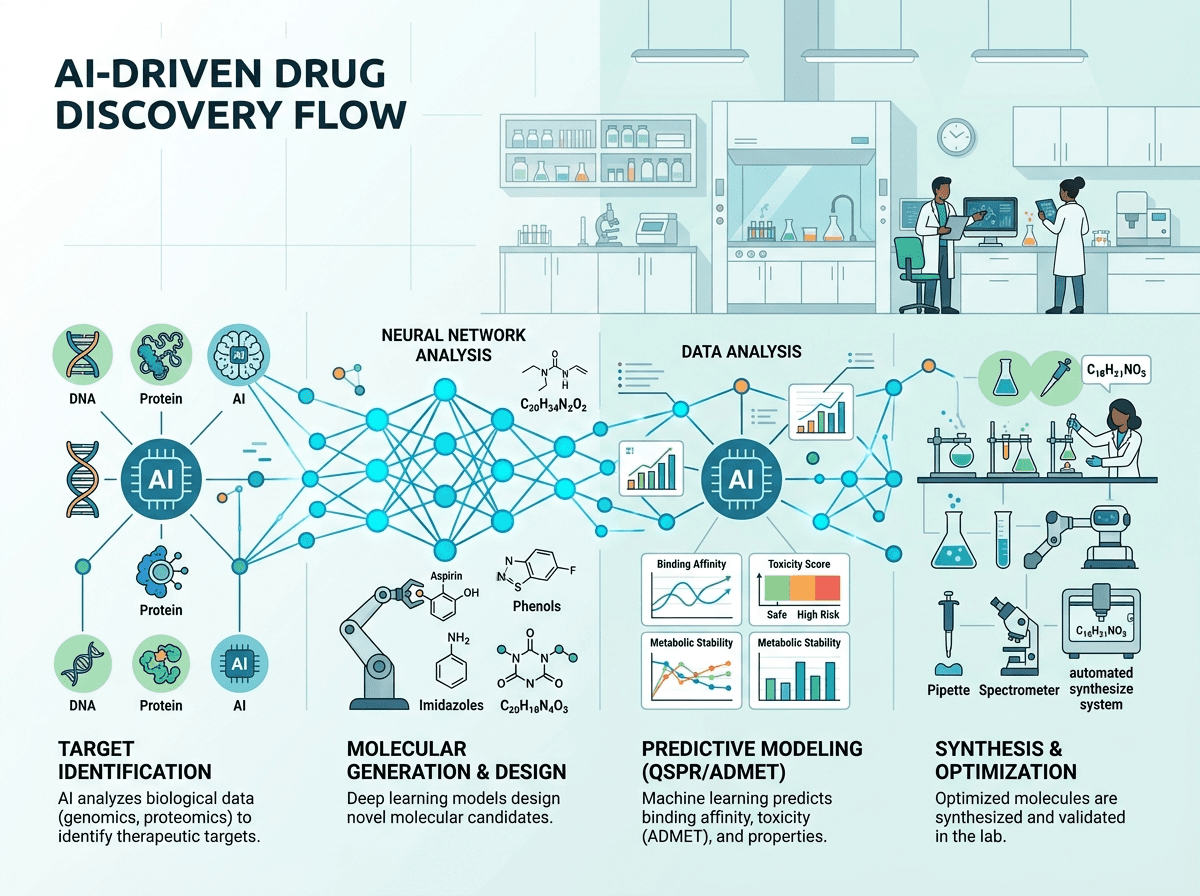
Unlike generalist models, GPT-Rosalind has been trained and optimized to meet the very specific demands of life sciences research. In concrete terms, this translates into four major differentiating capabilities:
- Advanced biological reasoning: the model can analyze complex cellular mechanisms, interpret experimental results, and propose scientifically coherent hypotheses.
- Expertise in medicinal chemistry: GPT-Rosalind can assist researchers in molecule design, chemical structure analysis, and assessment of pharmacological properties.
- Genomic analysis: the model processes and interprets sequencing data, facilitates gene annotation, and accelerates the identification of therapeutic targets.
- Experimental workflow automation: it can structure, document, and optimize laboratory protocols, reducing human errors and delays.
For French R&D teams that juggle daily between growing data volumes and tight time and budget constraints, these functionalities represent considerable productivity leverage.
Concrete Applications for French Life Sciences Companies
France boasts a particularly dense industrial ecosystem in life sciences: Sanofi, Servier, L'Oréal, Danone, Limagrain, plus hundreds of biotech startups from the France 2030 ecosystem. Here's how GPT-Rosalind can transform their operations starting today.
In the pharmaceutical industry, drug discovery can take 10 to 15 years and cost billions of euros. GPT-Rosalind can accelerate the virtual screening phase by analyzing chemical compound libraries, predicting their interactions with biological targets, and generating analysis reports that researchers would have taken weeks to produce manually.
In cosmetics and beauty, players like L'Oréal or LVMH Beauty can use this type of model to accelerate the formulation of active ingredients, analyze interactions between components, and anticipate skin tolerance issues while integrating European regulatory constraints (REACH, cosmetic regulation).
In food and agriculture and seeds, companies can leverage genomic analysis capabilities to accelerate variety selection, optimize industrial fermentation, or identify quality biomarkers in their raw materials.
In biotech and medtech, startups can now have a high-level scientific assistant without recruiting an army of specialists, dramatically reducing time-to-market on innovation projects.
Regulatory and Ethical Issues Not to Neglect
While opportunities are real, French companies must approach GPT-Rosalind with lucidity and rigor. Several points require careful attention.
First, the question of data and digital sovereignty. Sending confidential research data—genomic sequences, proprietary chemical formulas, clinical data—to OpenAI's cloud model raises legitimate questions about GDPR compliance and protection of trade secrets. CIOs and DPOs will need to carefully evaluate usage conditions, consider on-premise deployments, or secure private environments.
Second, scientific validation remains essential. GPT-Rosalind, however powerful, remains a decision-support tool. In domains where an error can have consequences for human health, no model recommendation should be applied without validation by qualified human experts. European regulations on medical devices (MDR) and clinical trials impose standards of proof that AI alone cannot satisfy.
Third, the risk of technological over-dependence. Companies that integrate GPT-Rosalind into critical processes must plan for continuity and avoid creating one-sided dependencies on a single supplier.
Training Your Teams: The True Competitive Advantage
Introducing a tool like GPT-Rosalind is not simply a software subscription. The real challenge—and true competitive advantage—lies in your teams' ability to fully exploit these new capabilities in a critical and informed manner.
This requires multiple levels of training:
- Researchers and scientists must understand the strengths and limitations of language models applied to their field: how to formulate effective requests (scientific prompt engineering), how to interpret outputs, and how to detect hallucinations or factual errors.
- R&D managers and project leaders must be able to identify high-ROI use cases, pilot AI integration into existing workflows, and evaluate the quality of produced results.
- IT and data teams must master API integration challenges, data security, and governance of AI models in a demanding regulatory context.
- Leadership and decision-makers must have a clear strategic vision to arbitrate investments, manage risks, and position the company in a rapidly evolving ecosystem.
Ignoring the human dimension of this transformation exposes you to deploying costly tools that will never be used to their full potential—or worse, used incorrectly, with potentially serious consequences in sectors as sensitive as healthcare.
Take Action with Ikasia
The emergence of GPT-Rosalind illustrates a fundamental trend: generalist AI is gradually giving way to vertical, specialized models deeply rooted in business realities. French life sciences companies that can anticipate this transition will gain a lasting competitive advantage over their European and global competitors.
At Ikasia, we support French companies in their AI transformation: from identifying priority use cases to operational training for teams, including defining responsible adoption strategies aligned with European regulatory requirements.
Are you in life sciences, pharmaceuticals, cosmetics, or food and agriculture and want to understand concretely what GPT-Rosalind can bring to your organization? Contact our experts at ikasia.ai for a free personalized assessment. Because in the innovation race, what makes the difference isn't the tool—it's your ability to use it better than others.
Tags
Related articles

GPT-5: How Two Simple Settings Tripled AI Performance — What This Means for Your Business
Read
Project Camellia: When OpenAI Builds Data Centers, French Businesses Must Rethink Their AI Strategy
Read
Google Finance Exits Beta: What the AI-Powered Financial Analysis Revolution Means for French Businesses
ReadWant to go further?
Ikasia offers AI training designed for professionals. From strategy to hands-on technical workshops.