Healthcare Robotics and Physical AI: NVIDIA Opens a New Era for Care Facilities
The convergence between artificial intelligence and robotics is no longer a futuristic promise: it is now an operational reality. NVIDIA has just reached a major milestone by publishing the first dataset dedicated to healthcare robotics, accompanied by foundational physical AI models specially designed for hospital environments. For French healthcare players — private clinics, hospital groups, medical device manufacturers or health software publishers — this announcement is not a signal to monitor from afar. It is a transformation catalyst to integrate into your strategic roadmap starting today.
What NVIDIA Really Launched: Far More Than Just a Dataset
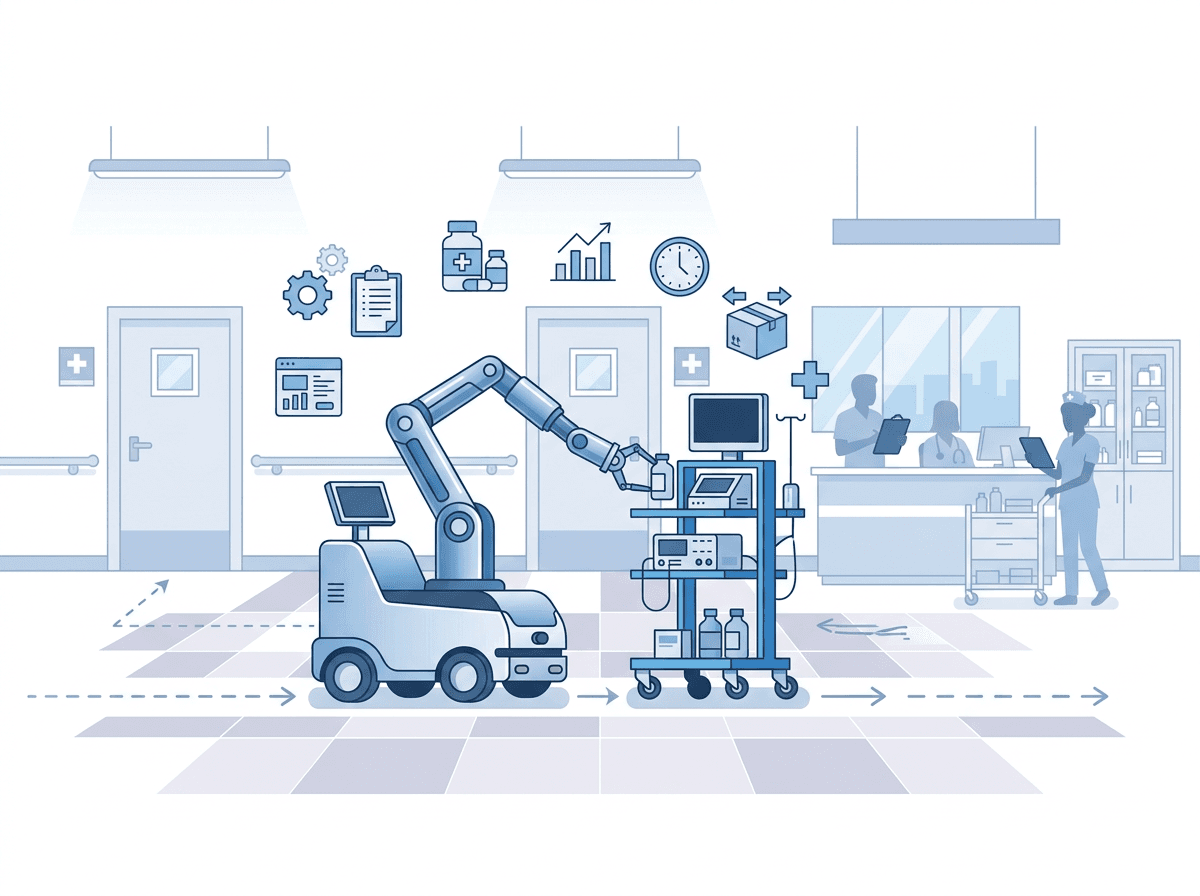
Behind the technical announcement lies a decisive infrastructure for the entire health-tech ecosystem. NVIDIA has made available on Hugging Face an unprecedented dataset, consisting of movement sequences, physical interactions and typical scenarios from care environments: tray transport, mobility assistance, medical equipment handling, navigation through crowded corridors.
This dataset powers foundational physical AI models — that is, pre-trained models capable of understanding the real world in its physical complexity: trajectories, forces, obstacles, human-robot interactions. Concretely, a company or laboratory wishing to develop a hospital robot no longer has to start from scratch. It can rely on these foundations to train and fine-tune its own solutions, drastically reducing costs and time-to-market.
It's the equivalent, for healthcare robotics, of what GPT-4 has represented for natural language processing: a common foundation that democratizes access to capabilities once reserved for technology giants.
Concrete Applications for French Healthcare Companies
The operational implications of this breakthrough are numerous and affect very diverse segments of France's healthcare economy.
In hospitals and nursing homes, autonomous robots could handle internal logistics: medicine delivery to departments, linen or meal transport, automated room disinfection. These repetitive and time-consuming tasks currently mobilize healthcare staff under strain. By leveraging pre-trained models like those offered by NVIDIA, technology providers will be able to offer solutions adapted to the French context — Haussmannian architecture, narrow elevators, CNIL regulations — without massive R&D investments.
For medical device manufacturers and MedTech startups, this is an opportunity for repositioning. Players like Medtech SA (already present in surgical robotics) or the many startups of French Tech Santé can enrich their products with advanced physical learning capabilities by integrating these models into their development pipelines.
In the field of rehabilitation and assistance for disabled persons, exoskeletons and robotic assistance arms could directly benefit from these models to improve their ability to adapt to patient movements, making devices more intuitive and safer.
For French health insurers and mutual societies, seeking to control costs while improving care quality, supporting or co-investing in hospital robotics pilot projects becomes a credible and fundable strategy, notably through France 2030 initiatives or European funds dedicated to digital health.
Challenges to Anticipate: Regulation, Ethics and Systems Integration
While enthusiasm is legitimate, French companies must approach this transformation with clarity. Several structural obstacles deserve particular attention.
European regulation, particularly the Medical Device Regulation (MDR 2017/745) and the upcoming AI Act, imposes strict requirements for algorithm traceability, risk management and clinical validation. A physical AI model used in a care context will likely need to be qualified as a Class II or III medical device depending on its use, implying lengthy and costly certification processes.
Integration into existing Hospital Information Systems (HIS) represents another major undertaking. EHRs (Electronic Health Records), often heterogeneous and poorly interoperable, will need to evolve to communicate with autonomous robots generating real-time data.
Social acceptability, finally, must not be underestimated. French healthcare workers, attached to the human dimension of care, must be involved from the design phase of projects to avoid resistance to change that has often caused well-designed technological deployments to fail.
Training Teams: The Invisible Yet Decisive Challenge
The adoption of physical AI in healthcare environments will not happen without significant upskilling of teams. And this is precisely where many organizations underinvest.
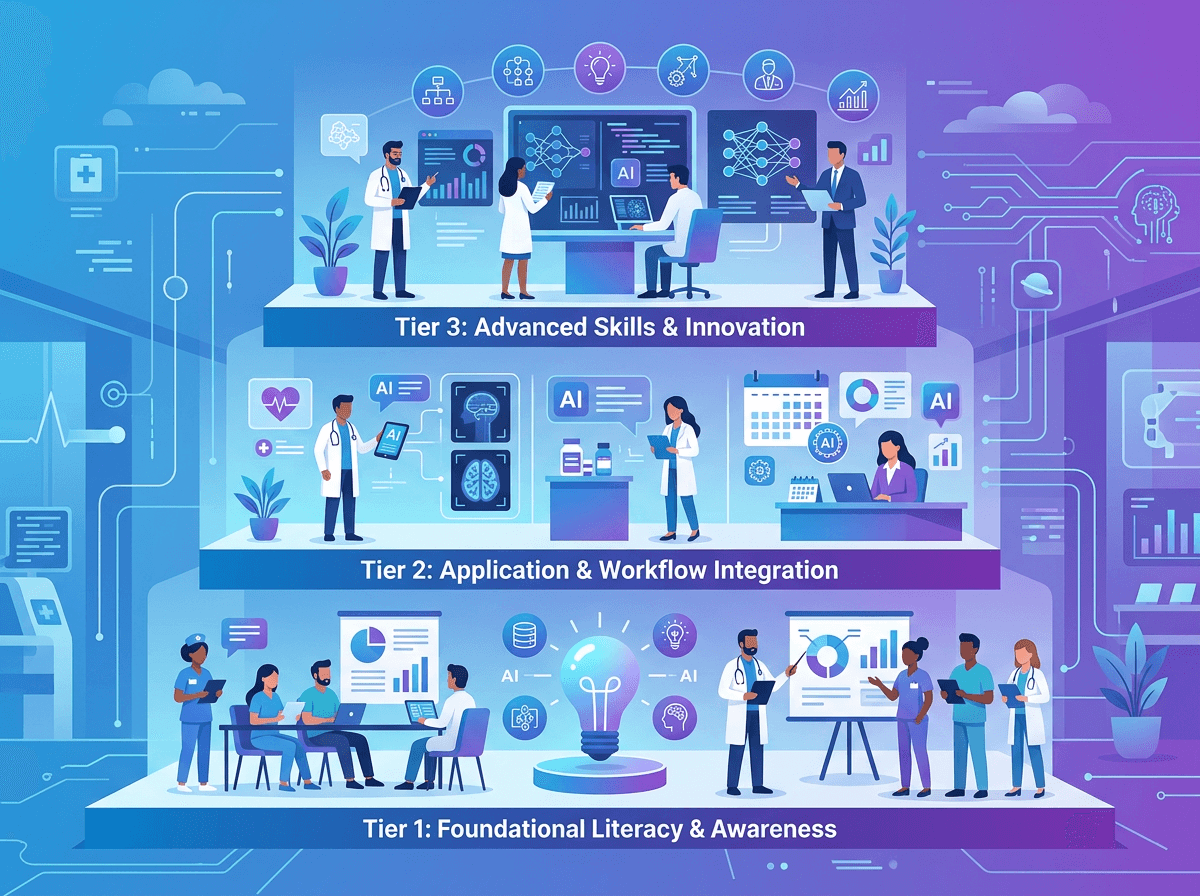
Three levels of training are necessary in parallel. At the strategic level, general management and CIOs must understand the possibilities offered by these new AI architectures to make investment decisions and manage technology partnerships. At the operational level, healthcare teams and health managers must be trained to work alongside robotic systems, to interpret their behavior and manage exceptional situations. At the technical level, data and IT teams must master the concepts of fine-tuning foundational models, managing physical data and deploying embedded systems in constrained environments.
Ignoring this training dimension exposes you to costly deployments that never reach their full potential. Organizations that invest now in AI culture across their teams will gain considerable advantage over competitors over the next 18 to 36 months.
Take Action with Ikasia
At Ikasia, we support French companies in their AI transformation — from strategic understanding of challenges to operational upskilling of your teams. Whether you are a healthcare player wanting to assess the potential of AI robotics in your organization, or a technology provider seeking to integrate these new capabilities into your offering, we can help you structure your approach.
Discover our training and consulting programs at ikasia.ai and let's together understand the opportunities opening up for you.
Tags
Related articles
How NVIDIA Reinvents Chip Design with AI: Concrete Impact for French Businesses
Read
NVIDIA Cosmos 3: How Physical AI is Redefining Industry and Robotics for French Enterprises
Read
Autonomous Networks and Agentic AI: What NVIDIA's Telecom Revolution Means for Your Business
ReadWant to go further?
Ikasia offers AI training designed for professionals. From strategy to hands-on technical workshops.