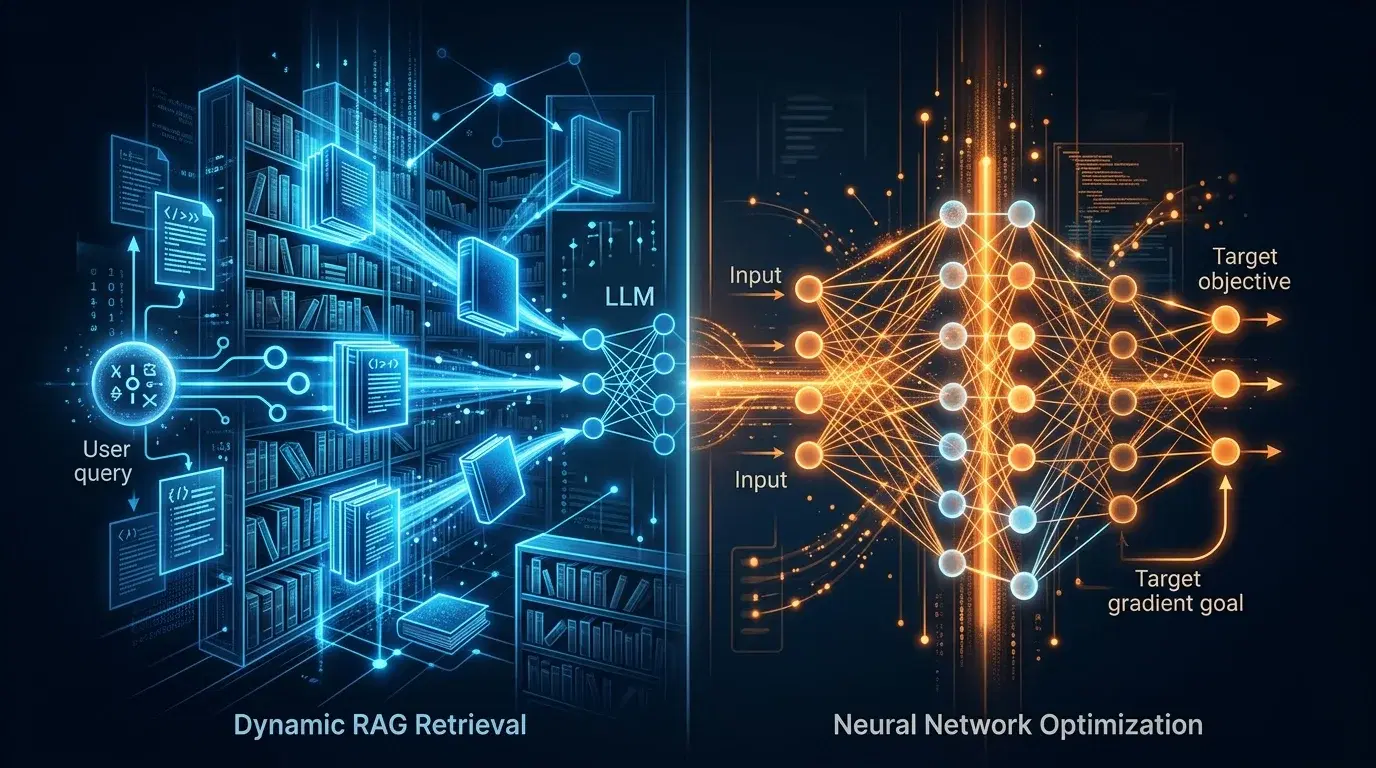
Enterprises sitting on decades of proprietary knowledge face a critical architectural decision: should they fine-tune a large language model on their data, or should they use Retrieval-Augmented Generation (RAG)? The wrong choice costs hundreds of thousands in GPU hours, introduces compliance risks, or produces inaccurate answers. This guide provides a decision framework grounded in real 2026 implementations.
Key takeaways: RAG is the default choice for enterprise knowledge bases in 2026. It is cheaper, faster to deploy, easier to update, and fully compliant with GDPR's right to erasure. Fine-tuning is reserved for niche use cases requiring stylistic consistency, specialized reasoning, or extremely low-latency inference. Most enterprises should start with RAG and only consider fine-tuning after 6-12 months of validated production use.
What RAG and Fine-Tuning Actually Do
RAG (Retrieval-Augmented Generation)
RAG does not modify the base model. Instead, it:
- Converts your documents into vector embeddings
- Stores them in a vector database (Pinecone, Weaviate, pgvector)
- At query time, retrieves the most relevant chunks
- Injects those chunks into the prompt as context
- Asks the base model to answer based only on the provided context
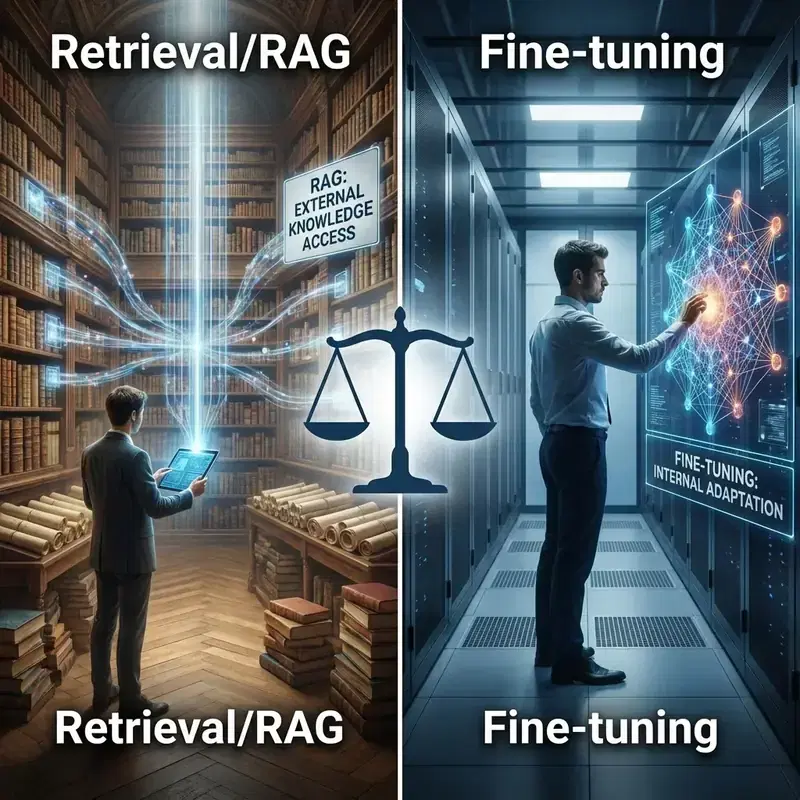
Analogy: RAG is like giving a lawyer a curated file of case documents before asking a question. The lawyer's brain (the LLM) hasn't changed — but their answer is grounded in your specific documents.
Fine-Tuning
Fine-tuning modifies the model's weights by training it on your proprietary dataset. The model learns new patterns, styles, and facts embedded in your data.
Analogy: Fine-tuning is like sending the lawyer to law school again, but this time the curriculum consists entirely of your case history. The lawyer's brain has literally changed.
The 6-Dimension Comparison Matrix
| Dimension | RAG | Fine-Tuning | Winner |
|---|---|---|---|
| Setup cost | €5K–€20K (infrastructure + embedding) | €50K–€500K+ (GPU cluster, data prep, training) | RAG |
| Time to production | 2–6 weeks | 2–6 months | RAG |
| Update cost | Minutes (add/delete documents) | Days–weeks (retrain model) | RAG |
| Latency | 1–3 seconds (retrieval + generation) | 0.5–2 seconds (generation only) | Fine-Tuning |
| Accuracy on facts | High (grounded in source docs) | Variable (model may hallucinate or memorize incorrectly) | RAG |
| Accuracy on style | Medium (inherits base model style) | High (learns your company's tone and terminology) | Fine-Tuning |
| Data privacy | Excellent (data stays in vector DB, never touches model weights) | Poor (data permanently embedded in model weights) | RAG |
| Right to erasure (GDPR) | Trivial (delete vector) | Nearly impossible (data inextricable from weights) | RAG |
| Hallucination risk | Low (constrained by context) | Medium–High (model may "remember" incorrectly) | RAG |
| Explainability | High (cite source documents) | Low (black-box weights) | RAG |
When RAG Is the Right Choice
Use case 1: Internal knowledge base (IT helpdesk, HR policies, compliance)
Why RAG: Documents change frequently. A new HR policy or software update must be reflected immediately. RAG updates in minutes; fine-tuning requires retraining.
Implementation pattern:
- Chunk documents into 500-token segments with 100-token overlap
- Embed using
text-embedding-3-largeorCohere embed-v3 - Store in pgvector or Pinecone with metadata filtering (department, access level)
- Retrieve top-5 chunks, rerank with Cohere Rerank or cross-encoders
- Generate with GPT-4o or Claude 3.5 Sonnet with strict system prompt
Use case 2: Customer-facing Q&A (product documentation, FAQs)
Why RAG: GDPR compliance is non-negotiable. If a customer requests deletion, RAG allows instant removal. Fine-tuning makes erasure technically infeasible.
Implementation pattern:
- Sync vector DB with CMS (webhook on publish/update/delete)
- Add source citation in UI ("Source: Product Manual v4.2, page 15")
- Implement guardrails to prevent answers from outdated documents
Use case 3: Multi-domain enterprise search (across departments)
Why RAG: Different departments have different documents, access rights, and update cadences. RAG handles this via metadata filtering and separate collections. Fine-tuning would require a separate model per domain.
When Fine-Tuning Is the Right Choice
Use case 1: Specialized reasoning (medical diagnosis, legal analysis, engineering)
Why fine-tuning: The base model lacks domain-specific reasoning patterns. A medical AI must learn how to weigh symptoms, order tests, and rule out conditions — not just retrieve documents.
Requirements:
- 10,000+ high-quality labeled examples
- Domain experts for data validation
- Budget for iterative training runs
- Regulatory approval (for medical use)
Use case 2: Stylistic consistency (brand voice, legal drafting, creative writing)
Why fine-tuning: RAG cannot make the model "sound like your brand." Fine-tuning on your company's best content adapts vocabulary, sentence structure, and tone at the weight level.
Example: A luxury fashion brand wants all product descriptions to feel poetic and evocative. RAG retrieves facts; fine-tuning teaches the model to write like the brand.
Use case 3: Extremely low-latency inference (real-time applications)
Why fine-tuning: RAG adds 500ms–2s of retrieval latency. For real-time applications (voice assistants, trading algorithms), fine-tuning a smaller model (Llama 3 8B, Mistral 7B) on-premise achieves sub-second response without retrieval.
The Hybrid Approach: RAG + Fine-Tuning
When to combine both
The most sophisticated enterprise implementations use both:
- Fine-tune a base model on domain reasoning and style (layer 1: "how to think and write")
- Add RAG on top for factual grounding (layer 2: "what to know right now")
Example: Legal AI assistant
- Fine-tuned model (on 50,000 court decisions + legal reasoning): learns how to structure legal arguments, cite precedents, and draft motions
- RAG layer (on current case files + active legislation): grounds answers in the specific matter at hand
- Result: The assistant writes like a senior partner and knows the current case facts
Cost reality check
Hybrid approaches cost 2–3x more than RAG alone. Reserve them for high-value use cases where accuracy and style directly impact revenue or risk.
Security and Compliance Considerations
Data residency
| Approach | Where does your data live? |
|---|---|
| RAG (self-hosted vector DB) | Your infrastructure (EU, if you choose) |
| RAG (managed Pinecone/Weaviate) | Vendor's cloud (verify region) |
| Fine-tuning (API) | Vendor's training cluster (usually US) |
| Fine-tuning (self-hosted) | Your infrastructure (requires GPU cluster) |
Recommendation: For GDPR-sensitive data, use self-hosted RAG (pgvector + local LLM via Ollama/vLLM) or EU-hosted managed services.
Model versioning
With RAG, you can A/B test retrieval strategies without changing the model. With fine-tuning, every training run produces a new model version that must be validated, staged, and rolled back if issues arise. MLOps overhead is 3–5x higher with fine-tuning.
2026 Decision Tree
START: Enterprise Knowledge Base Project
│
├─→ Need to update content frequently? ──→ YES ──→ Use RAG
│
├─→ Need GDPR right-to-erasure? ──→ YES ──→ Use RAG
│
├─→ Budget < €50K? ──→ YES ──→ Use RAG
│
├─→ Timeline < 2 months? ──→ YES ──→ Use RAG
│
├─→ Need specialized reasoning not in base model? ──→ YES ──→ Consider Fine-Tuning
│
├─→ Need brand voice consistency across all outputs? ──→ YES ──→ Consider Fine-Tuning
│
├─→ Need sub-second latency without retrieval? ──→ YES ──→ Consider Fine-Tuning
│
└─→ Otherwise ──→ Start with RAG, evaluate fine-tuning at month 6
Conclusion
For 80% of enterprise knowledge base use cases in 2026, RAG is the correct answer. It is faster, cheaper, more compliant, and easier to maintain. Fine-tuning remains a powerful tool for the 20% of cases requiring specialized reasoning, stylistic control, or extreme latency optimization.
The enterprises that succeed are those that start simple with RAG, measure real user outcomes, and only escalate to fine-tuning when the business case is unambiguous.
Need architectural guidance? Ikasia designs and implements enterprise RAG systems and provides workshops on LLM deployment for European enterprises. From proof-of-concept to production, we handle architecture, compliance, and scaling.
FAQ
Can RAG work with unstructured data (PDFs, scans, images)?
Yes. Modern RAG pipelines include OCR (Tesseract, Azure Document Intelligence), table extraction, and multimodal embeddings (CLIP for images). Unstructured data is parsed, chunked, and embedded just like text.
How much data do I need for fine-tuning?
Minimum 1,000 high-quality examples. For serious results, 10,000–50,000 examples are typical. Quality matters more than quantity: 1,000 curated, labeled examples outperform 10,000 noisy ones.
Does fine-tuning prevent hallucinations?
No. Fine-tuning can reduce hallucinations on topics covered in the training data, but it can also introduce new hallucinations by overfitting. RAG with source citation is generally more reliable for factual accuracy.
Can I fine-tune on my laptop?
Not realistically. Fine-tuning a 7B parameter model requires 1–4x A100 GPUs (40GB VRAM each). For a 70B model, you need a cluster. Use cloud providers (AWS SageMaker, Google Vertex, Lambda Labs) or consider parameter-efficient methods (LoRA, QLoRA) that reduce VRAM requirements by 10x.
Guillaume Hochard is the founder of Ikasia, a Paris-based AI consulting firm. He advises European enterprises on LLM architecture, RAG implementation, and AI infrastructure strategy.
Tags
Related courses
Related articles
Want to go further?
Ikasia offers AI training designed for professionals. From strategy to hands-on technical workshops.