Real-Time Voice AI: How GPT-Live Redefines Customer Relations and Business Applications in Enterprise

Voice has always been the most natural communication channel between humans. Yet for years, businesses have had to work with rigid voice assistants, star-key menus, and response times that shattered any sense of fluidity. With OpenAI's announcement of GPT-Live, a system for continuous, real-time voice interaction, a new era is opening — and businesses worldwide have every reason to grasp its implications right now.
In a context where customer relationships are a major competitive differentiator and teams are under pressure to do more with less, this technological breakthrough is not trivial. It is transformative.
What GPT-Live Really Changes: The End of Artificial Turn-Taking
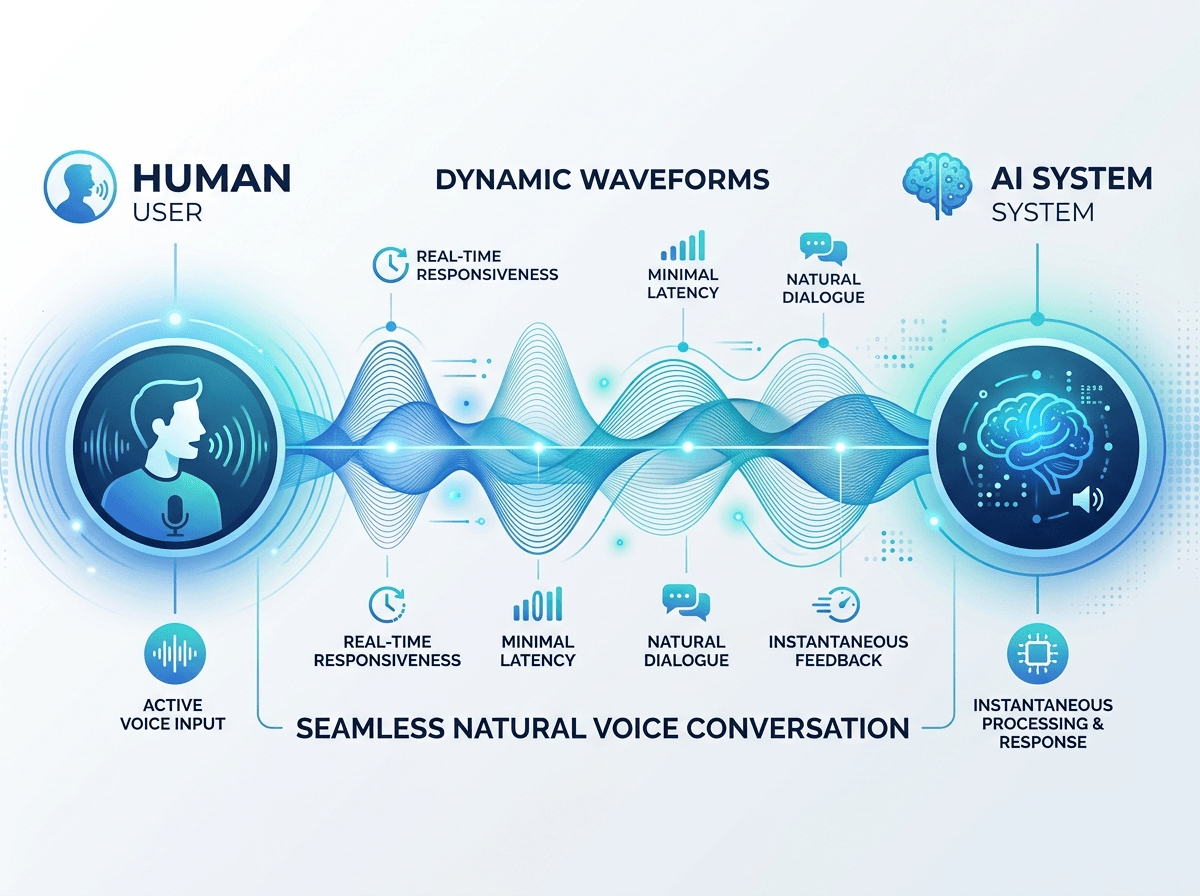
To understand the magnitude of this shift, we must revisit the main limitation of previous voice AIs: the turn-based conversation model. Like an old walkie-talkie, the user speaks, waits for the AI to "process," then receives a response. This mechanic introduces enormous cognitive friction — it simply doesn't resemble a real conversation.
GPT-Live breaks this paradigm with a turnless speech model combined with ultra-low-latency architecture. Concretely, this means the AI can:
- Interrupt and be interrupted naturally, as in real conversation
- Respond in tens of milliseconds, versus several seconds previously
- Adapt pace and tone based on the emotional context of the exchange
- Maintain conversational flow across long, complex exchanges
For businesses, this difference is not merely technical. It is psychological and commercial: a customer who perceives fluid conversation trusts the system more, stays on the line longer, and converts better.
Concrete Applications for Businesses
The sectors that can immediately benefit from this technology are numerous. Here are a few use cases already conceivable within 12-18 months:
Customer Service and Contact Centers Customer relationship platforms are in the front line. Imagine an AI agent capable of handling an incoming call about an insurance claim, understanding the interruptions of a frustrated customer, reformulating in real-time, and proposing a solution without ever "losing focus mentally." Players like insurers, telecom operators, or retail chains could deploy voice assistants that are no longer distinguishable from humans in terms of fluidity.
Field Sales Support A sales representative on the go can interact vocally with their CRM without taking their eyes off the road. "What's the order history of the client I'll see in 20 minutes?" — the answer arrives instantly, conversationally, without friction.
Training and Onboarding New employees can practice voice simulations with an AI playing the role of a difficult customer, a demanding manager, or a supplier in negotiation. The system's natural responsiveness makes these simulations far more effective than old static e-learnings.
Medical and Healthcare Sector Voice assistants for healthcare professionals (real-time dictation notes, differential diagnosis support, protocol reminders) could leverage this technology for use cases where speed and precision are critical — while respecting French regulatory constraints (GDPR, HDS hosting).
Internal IT and HR Support Rather than consulting a static knowledge base, an employee can simply ask a voice AI assistant for the steps to submit an expense report, understand their leave entitlements, or resolve a technical issue. The adoption barrier collapses when the interface is voice.
Challenges to Anticipate: Sovereignty, Compliance, and Integration
While enthusiasm is legitimate, businesses must approach this shift with clarity. Several issues deserve particular attention.
The question of data sovereignty is central. Voice streams capture not only the content of exchanges, but also biometric data (voice, intonation, emotional state). GDPR imposes a strict framework: explicit consent, data minimization, right to erasure. DPOs must be involved from the design phase of voice AI projects.
Network latency remains a limiting factor in regions outside major metropolitan areas. A real-time system is truly real-time only if the underlying infrastructure allows it. Businesses will need to evaluate their cloud and edge computing architectures accordingly.
Integration with existing systems (CRM, ERP, business tools) often represents the real challenge. Voice AI technology is only powerful if it's connected to company data and processes. That's where the complexity — and the added value of expert support — lies.
Finally, internal acceptability must not be underestimated. Teams in customer-facing roles may perceive these tools as a threat rather than support. Change management is non-negotiable.
Training Teams for the Era of Voice AI: A Strategic Imperative
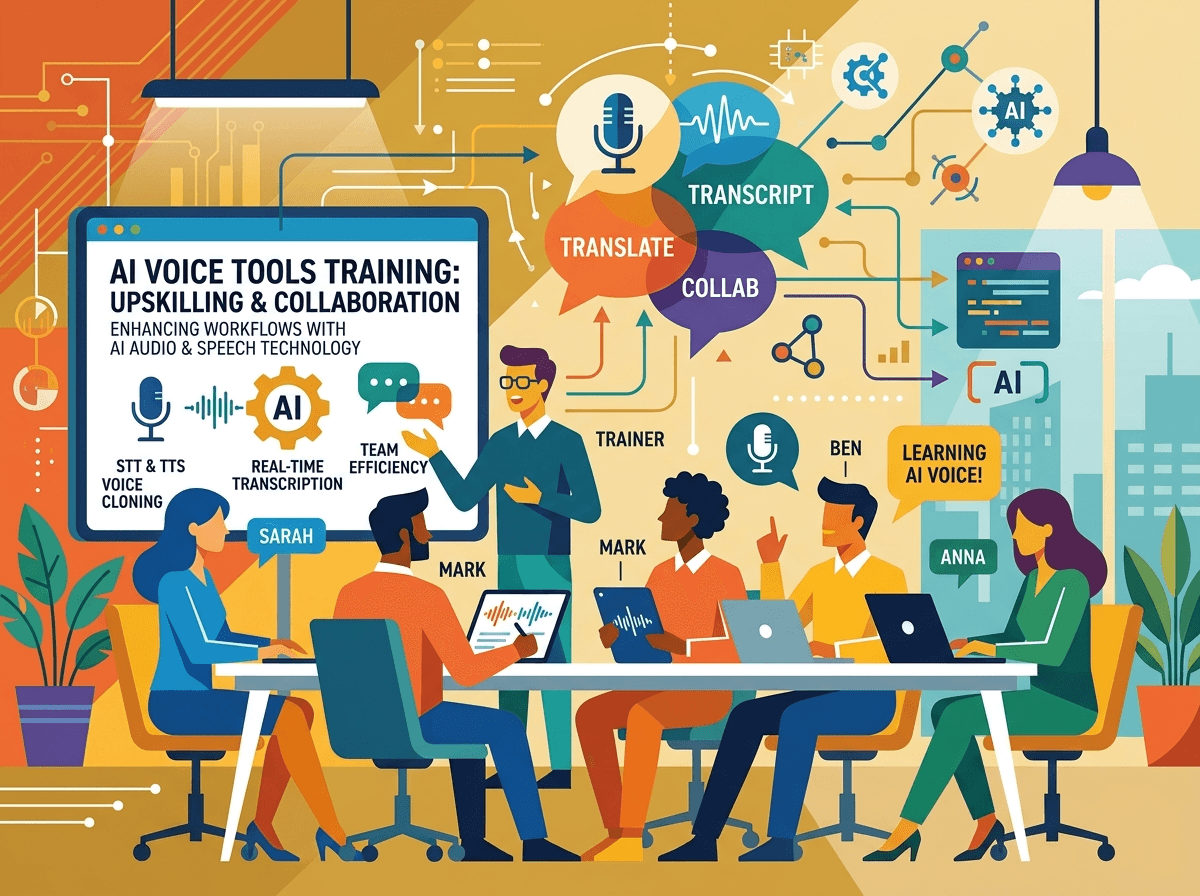
The emergence of real-time voice AI does not render human skills obsolete — it reconfigures them. Employees who can work with these systems, configure them, evaluate them, and improve them will create the most value in the years to come.
Concretely, this means training teams across several dimensions:
- Understanding how voice language models work to better define what they can and cannot do
- Designing scripts and conversational flows adapted to new capabilities (turnless, with interruptions, with contextual memory)
- Measuring performance of voice AI interactions with relevant KPIs (first-contact resolution rate, perceived satisfaction, escalation rate to human agents)
- Managing biases and errors: a voice AI system may misunderstand certain accents, cultural contexts, or technical formulations. Teams must be able to identify and correct these drifts
- Adopt a continuous improvement posture: models evolve quickly, use cases too. Training can no longer be a one-time event — it must become regular practice
At Ikasia, we support businesses in building this expertise, from strategic awareness to hands-on workshops on voice AI tools. Our approach combines technical expertise and knowledge of real-world business challenges to ensure transformation is sustainable, not merely experimental.
GPT-Live is a clear signal: the boundary between human and machine interaction continues to blur. Businesses that integrate this reality into their strategy today — by training their teams, rethinking their processes, and choosing the right partners — will gain significant advantage.
Want to explore how voice AI can transform your organization? Contact Ikasia's experts at ikasia.ai for a personalized diagnosis and discover our training programs tailored to your business needs.
Tags
Related articles



Want to go further?
Ikasia offers AI training designed for professionals. From strategy to hands-on technical workshops.