Specialized AI Without Compromise: How AWS Nova Forge Is Transforming Enterprise Customer Classification
One of the most frustrating challenges for organizations adopting artificial intelligence is this: how do you make a model specialized enough to meet precise business needs, without losing its ability to reason in a general, flexible way? Until now, the answer was often a painful compromise. With Nova Forge, AWS has demonstrated that it is now possible to sidestep this dilemma entirely — and the implications for enterprise organizations are significant.
The Specialization Dilemma: A Real Barrier for Enterprise IT Leaders
In many large enterprises and mid-sized organizations, data science teams face a recurring problem: general-purpose large language models (LLMs) perform brilliantly across a wide range of tasks, but as soon as you try to fine-tune them on domain-specific data — industry jargon, internal processes, proprietary customer databases — their overall performance degrades. In technical terms, this is known as catastrophic forgetting: the model effectively "unlearns" what it previously knew in order to absorb what it is being taught.
This phenomenon generates significant hidden costs: repeated fine-tuning iterations, increasingly complex data governance, and above all, a loss of trust among business teams in the AI tools being deployed. In an environment where executive leadership expects measurable ROI on AI investments, this kind of technical regression becomes a compelling argument against large-scale deployment.
This is precisely the problem that the AWS China Applied Science team set out to solve head-on with Nova Forge and its data mixing technique.
Nova Forge and Data Mixing: The Technique That Changes Everything
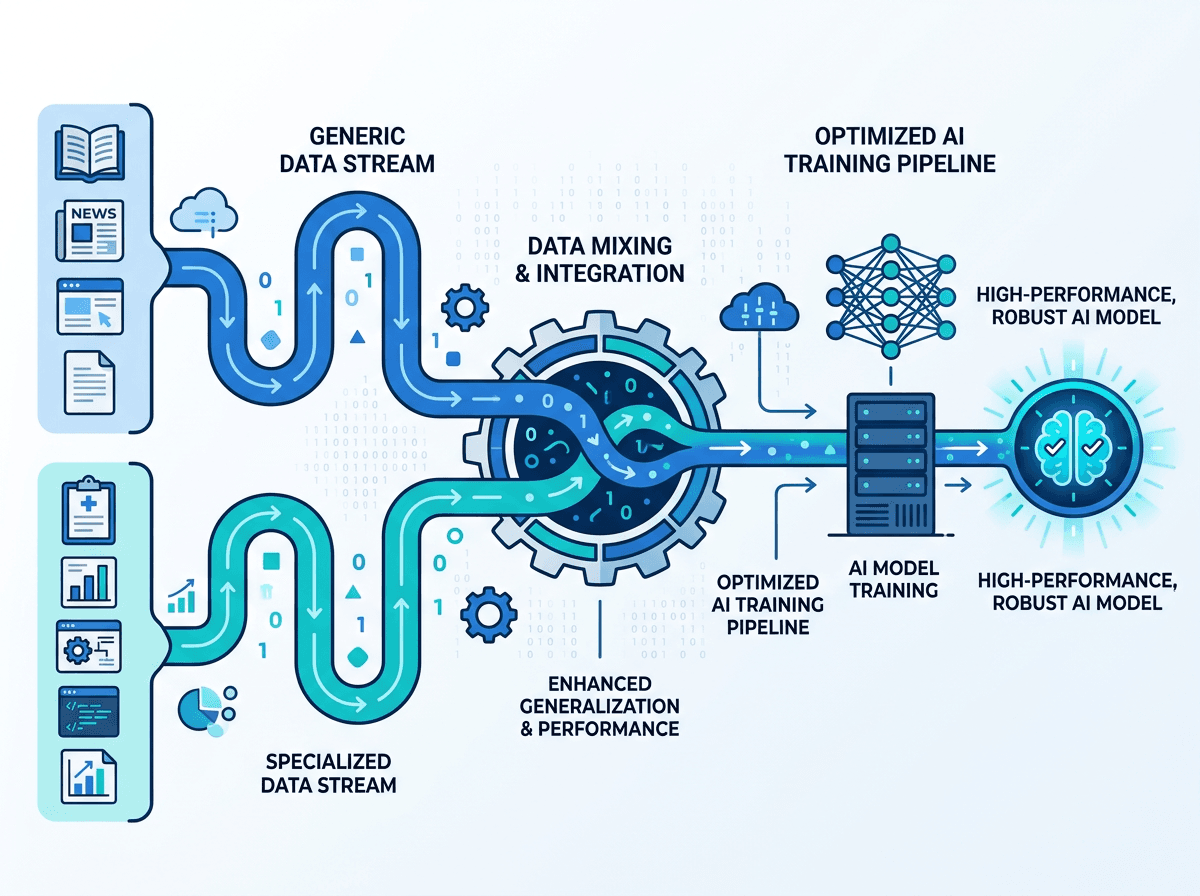
The Nova Forge approach is built on an elegant principle: rather than replacing general training data with specialized data during fine-tuning, the two are mixed in a calibrated way. The AWS team validated this approach on a particularly demanding task: Voice of Customer (VOC) classification — a use case directly applicable to thousands of businesses across industries.
The published results are striking. Compared to leading open-source reference models, Nova Forge manages to maintain — and in some cases improve — its general capabilities, while achieving remarkable accuracy on highly specific domain classification tasks. The key lies in the proportion and quality of the data mix: not so much general data that specialization is diluted, and not so much domain-specific data that catastrophic forgetting kicks in.
In practical terms, for a business such as an insurer, a retailer, or a telecommunications operator, this means it is now realistic to deploy a model capable of:
- Automatically classifying customer complaints into precise categories (refund requests, product defects, delivery delays, etc.)
- Generating a contextual summary for each support ticket
- Suggesting a response aligned with the company's tone of voice and internal policies
All of this without the model losing its capacity for nuanced reasoning or natural language understanding.
Real-World Applications Across Industries
Let's translate these advances into concrete operational contexts:
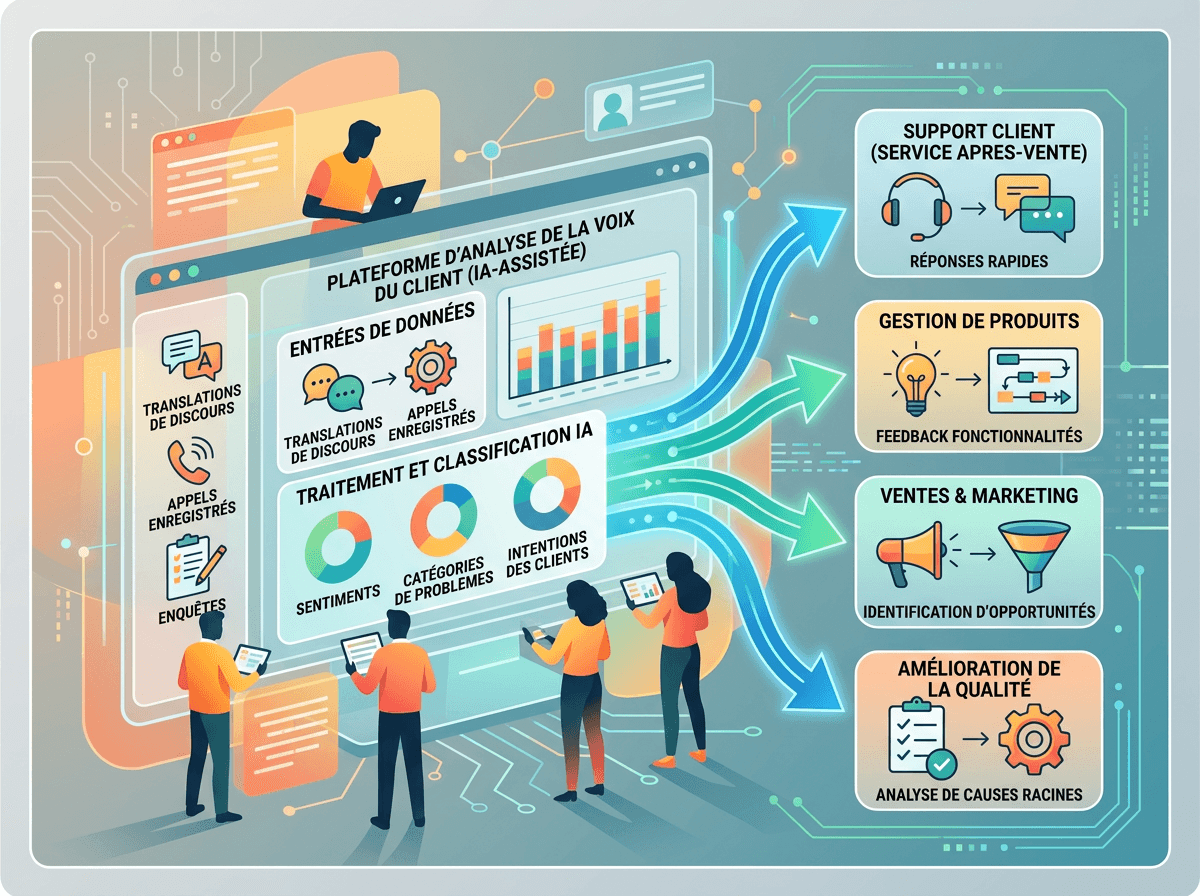
Retail and E-Commerce: A major grocery retailer or fashion e-commerce player can train Nova Forge on its historical customer contact data (chat logs, emails, transcribed calls) to build an automatic request triage engine. VOC classification makes it possible to identify in real time whether an incoming query relates to after-sales service, logistics, a payment issue, or an upselling opportunity — and to route it intelligently to the right team or automated response.
Banking and Insurance: Financial institutions operating under strict regulatory constraints (GDPR, PSD2, Solvency II) can use this approach to analyze post-subscription or post-claim customer satisfaction verbatims, automatically identifying early warning signals of churn or regulatory non-compliance — without deploying an overly broad general-purpose model on sensitive data.
Industry and B2B: An equipment manufacturer or industrial services provider can specialize Nova Forge on its technical lexicon to classify field reports from technicians, improve maintenance ticket management, and feed its internal knowledge base — while preserving the model's ability to produce reports that are intelligible to non-technical stakeholders.
Public Sector and Healthcare: Public agencies and healthcare institutions can leverage this technology to process large volumes of incoming correspondence or forms, automatically classifying requests and prioritizing urgent cases — with an AI that understands both specialized administrative language and plain everyday language used by end users.
Preparing Your Teams for the Era of Hybrid Specialized AI
The emergence of techniques like Nova Forge's data mixing is not merely a technological evolution: it is a strong signal for workforce upskilling. The organizations that will benefit most from these advances are those that invest in developing profiles capable of understanding the nuances of fine-tuning, training data quality, and rigorous model evaluation.
This requires training at several levels:
-
For data and IT teams: mastering the concepts of fine-tuning, comparative evaluation (benchmarking), and training data pipeline management. Understanding why the quality and diversity of the mixed data is just as critical as its volume.
-
For business teams: building a strong enough data culture to contribute meaningfully to annotation dataset construction, understanding what precision and recall rates mean in their operational context, and actively participating in model output validation.
-
For managers and executives: incorporating into their roadmaps the concept of evolving AI models — capable of being retrained as market conditions, customer behaviors, or regulations shift. AI is not a one-time project: it is a living asset that requires ongoing governance.
At Ikasia, we support organizations through exactly this transformation: from strategic awareness sessions for executive committees, to technical training for data teams, to scoping high-ROI use cases. Our approach combines applied AI expertise with a deep understanding of real-world operational challenges faced by modern enterprises.
Take Action with Ikasia
Advances like Nova Forge are not reserved for large American tech giants. With the right partners and the right training strategy, any mid-sized or large enterprise can build high-performing, robust, business-aligned AI systems today.
Want to assess how data mixing and specialized models could transform your customer-facing, operational, or HR processes? Explore our training and consulting programs at ikasia.ai and let's discuss your AI roadmap today.
Tags
Related courses
Related articles
Beyond Code: How Amp's AI Agents Are Redefining Enterprise Automation
Read
Long-form AI Video: How Higgsfield Is Transforming Content Production for Enterprises
Read
OpenAI on Amazon Bedrock: What Asia-Pacific Availability Means for French Enterprises Going Global
ReadWant to go further?
Ikasia offers AI training designed for professionals. From strategy to hands-on technical workshops.