Structured Outputs for Claude on Amazon Bedrock: The End of Unpredictable APIs for French Enterprises

Amazon has just crossed a decisive milestone for all enterprises integrating artificial intelligence into their business processes: the Anthropic Claude models, available on Amazon Bedrock, now natively support structured outputs. A technically subtle evolution, but one whose operational implications are considerable for IT directors, data teams, and French developers.
As a reminder, Amazon Bedrock is AWS's cloud platform that provides access to cutting-edge language models — including Anthropic's entire Claude family — without managing infrastructure. Until now, leveraging these models in production often involved a fair amount of improvisation: retry logic, custom parsers, post-processing validation… All of that is now a thing of the past.
What this technical update concretely changes
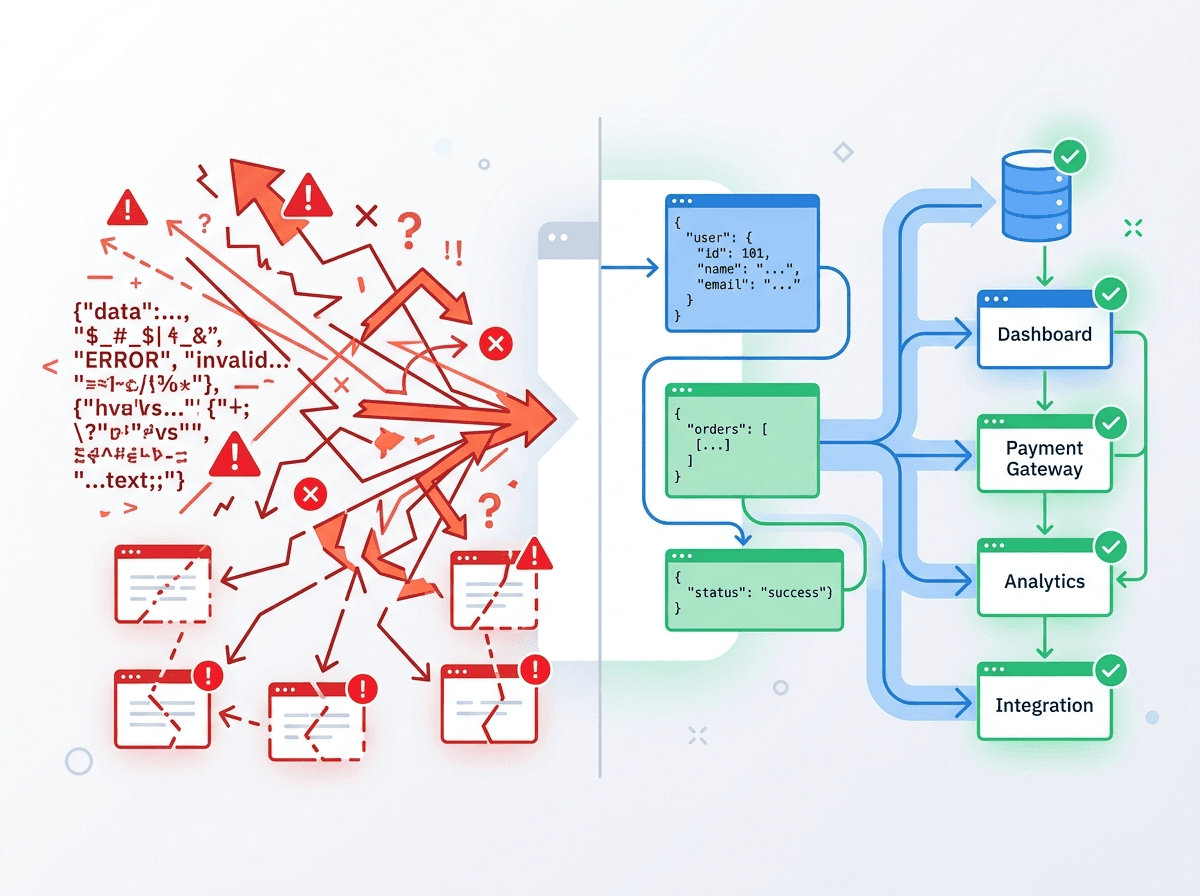
The new feature relies on two complementary mechanisms: the JSON Schema output format and strict tool use. In practice, this means you can precisely define the data structure you expect from the model — a JSON object with typed fields, mandatory properties, specific formats — and Claude will systematically conform to it, without deviation.
Before this update, the typical workflow for a technical team looked like this:
- Send a prompt to the model
- Receive a response in free text
- Attempt to extract JSON with a regex or parser
- Handle failure cases and retry the request
- Manually validate data consistency
This fragile pipeline was a constant source of production incidents, added latency, and hidden development costs. With native structured outputs, the model's response is directly usable by your application, without an intermediate layer.
The feature is available on both Bedrock endpoints — bedrock-runtime and bedrock-mantle — ensuring broad compatibility with existing architectures.
Business use cases that finally become industrializable
This evolution gains its full meaning in practical application for French enterprises. Here are three representative scenarios:
Automated extraction of contractual data — A law firm or procurement department can now feed Claude with contracts in plain text and receive as output a structured JSON object: stakeholders, key dates, termination clauses, amounts, currencies. All conforming to a predefined schema, ready to be injected into an ERP or CRM without human intervention.
Processing HR forms and documents — HR teams handling large volumes of CVs, training requests, or expense reports can configure a pipeline where Claude extracts relevant information into a standardized JSON structure, directly consumable by their HRIS. No more manual exports and time-consuming reformatting.
Automating customer support and lead qualification — A customer service tool based on Claude can now produce, with each interaction, a structured record: problem category, urgency level, detected sentiment, recommended actions, identified customer data. This data feeds real-time operational dashboards without any post-processing.
In each of these cases, output reliability is no longer a random variable: it is guaranteed by the schema. This is the shift from an experimental tool to a trusted infrastructure component.
Reliability and governance: central concerns for French enterprises
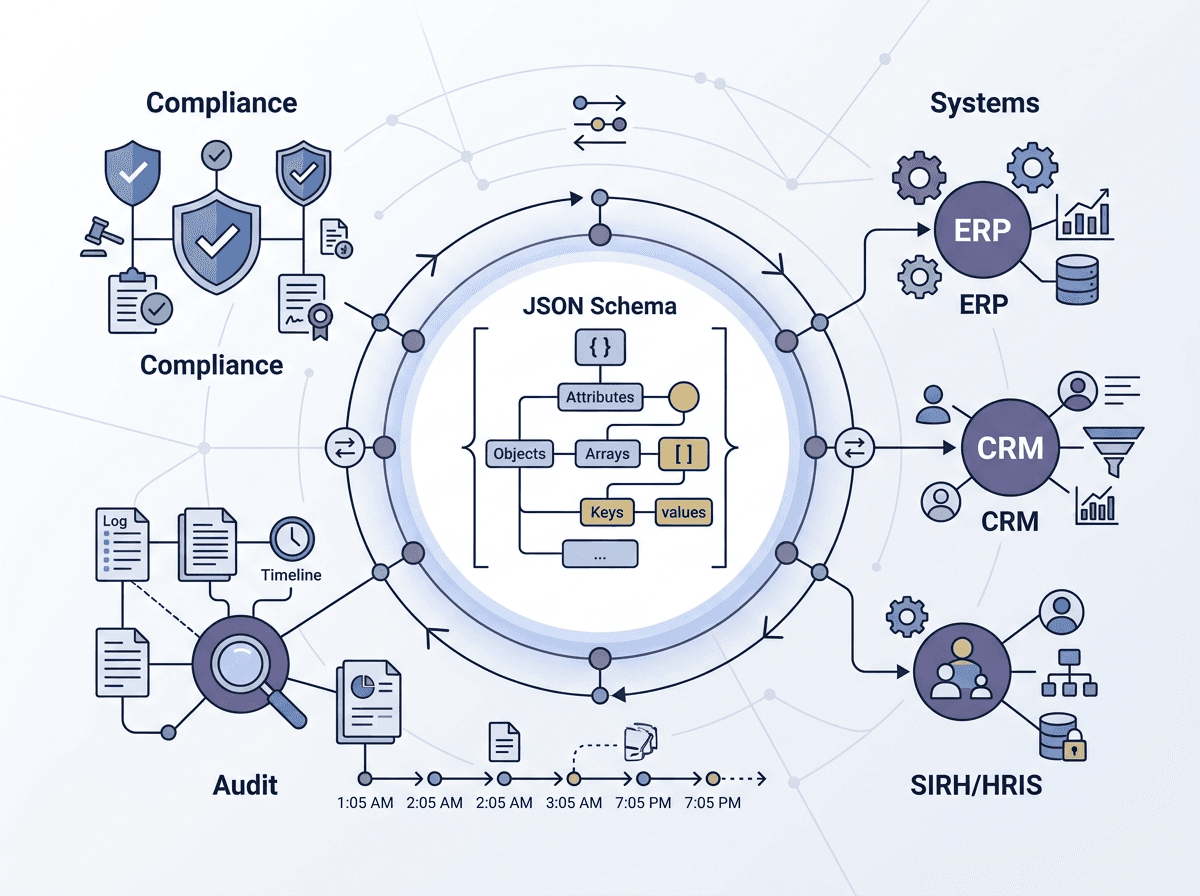
The question of AI system reliability is not trivial in the French and European regulatory context. The European AI Regulation (AI Act), whose initial provisions are progressively coming into force, imposes increasing requirements for traceability, predictability, and control of automated systems.
Structured outputs directly address several of these requirements. By defining a strict JSON schema, the enterprise formally documents what it expects from the model. By obtaining responses conforming to this schema, it can audit, log, and trace each interaction in a standardized manner. The variability inherent to LLMs — often criticized by legal and compliance departments — is mechanically reduced.
For enterprises subject to strong sectoral obligations (banking, insurance, healthcare, public sector), this increased predictability is a decisive argument for moving their AI projects from POC to large-scale production.
Moreover, integration into the AWS ecosystem allows enterprises to benefit from the security certifications already acquired by French IT departments — HDS, ISO 27001, GDPR compliance — without rearchitecting the entire data processing chain.
Training your teams to leverage structured outputs
Adopting this feature is not just about modifying a few lines of code. It requires a new way of conceiving interactions with language models: thinking in terms of data schemas before even drafting prompts, mastering JSON Schema, understanding the trade-offs between flexibility and constraint in defining expected structures.
For development teams, this means upskilling in structured prompt engineering — a discipline distinct from classical conversational prompting. For business teams and product managers, it involves knowing how to express their needs in terms of data structures, rather than solely in terms of expected text results.
At Ikasia, we regularly support French enterprises through this transition: from executive team awareness to technical implementation workshops on Bedrock, including designing use cases adapted to each organization's specific business needs. Our approach is resolutely pragmatic: start from existing processes, identify friction points that AI can resolve, and build robust solutions rather than demonstrations.
Mastery of tools like structured outputs on Bedrock is precisely what distinguishes anecdotal experimentation from AI deployment that creates sustainable value.
Would you like to evaluate how structured outputs can reliabilize your production AI projects? The Ikasia team is available for an initial strategic discussion with no obligation. Visit ikasia.ai to discover our training programs and consulting offerings, or to contact our experts directly. Because enterprise AI is built methodically.
Tags
Related articles

Claude on Amazon Bedrock in Asia: What AI Data Sovereignty Really Means for French Enterprises Operating Globally
Read
OpenAI on Amazon Bedrock: What Asia-Pacific Availability Means for French Enterprises Going Global
Read
GPT-5.6 on Amazon Bedrock: How Prompt Caching Reduces Your AI Costs by 80% and Transforms Enterprise Workflows
ReadWant to go further?
Ikasia offers AI training designed for professionals. From strategy to hands-on technical workshops.