AI Governance in the United States: How the American Model Changes Your Compliance Obligations and Strategy in France

Global artificial intelligence governance is entering a decisive phase. While the European Union has set the pace with the AI Act, the United States has just asserted a radically different approach: inverted federalism, where federal states experiment in a regulatory sandbox before standards rise to the national level. OpenAI, in a publicly noted stance, explicitly supports this approach and calls for coordination between state laws and federal framework to build "safe and democratic" AI.
For French companies — whether exporting to the United States, collaborating with American partners, or using AI tools developed across the Atlantic — this evolution is not a distant issue. It reshapes the contours of international compliance, supplier due diligence, and above all, the governance culture to be instilled internally.
The American "reverse federalism": decoding regulatory innovation logic
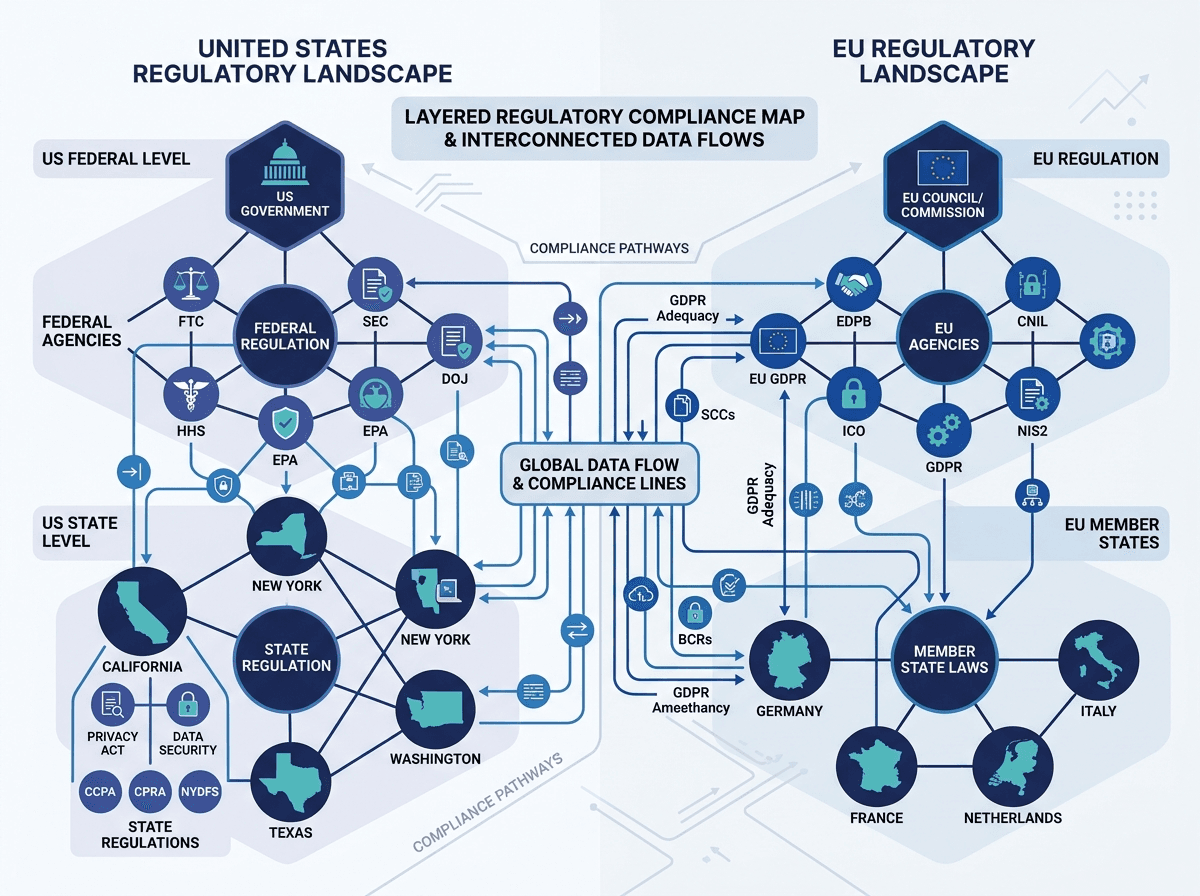
The concept defended by OpenAI rests on a counter-intuitive idea: letting states like California, Texas, or Illinois legislate first on specific topics — algorithmic transparency, bias in hiring systems, responsibility for generative models — so these local experiments then feed into a coherent federal framework.
This logic contrasts sharply with the European approach, centralized and normative from the start. Where Brussels sets the rules of the game for everyone, Washington lets the market and territories test, fail, and adjust. The expected result? Standards more grounded in operational realities of companies, and potentially more flexible to foster innovation.
What this means concretely: a French company deploying an AI-assisted recruitment tool for its American subsidiaries must navigate between Illinois requirements (AEDT Act on automated evaluation tools) and future federal obligations — while remaining compliant with the European AI Act. Regulatory mapping becomes a three-dimensional exercise.
Three direct impacts on French companies operating internationally
1. AI supplier due diligence becomes a strategic imperative
If your teams use AI solutions developed by American players — ChatGPT Enterprise, Microsoft Copilot, Salesforce Einstein, Google Gemini — you are exposed to the compliance evolution of these suppliers. Under pressure from American states, these tools are progressively integrating transparency, auditability, and explainability mechanisms.
Good news: these requirements largely converge with those of the AI Act. Bad news: timelines and scopes diverge. A rigorous supplier audit, updated semi-annually, is no longer optional for legal departments and IT leaders.
2. Transatlantic data under enhanced scrutiny
The American governance movement is accompanied by increased attention to data flows used to train or personalize models. Several states now require companies to document the origin of data processed by their AI systems. For Franco-American groups, this creates new friction zones between GDPR and local American requirements.
The solution lies in a sovereign and documented data architecture: knowing precisely which data feeds which models, in which territory, with what guarantees. This project, often postponed, is becoming urgent.
3. The reputational signal: anticipate rather than react
Large American companies voluntarily adhering to AI safety standards — before the law requires them — are building real competitive advantage. This movement toward proactive compliance is spreading rapidly in international tenders and investor ESG criteria.
For French mid-market and large groups, displaying a documented and audited AI governance policy becomes a commercial argument, particularly against American buyers or Anglo-Saxon investment funds.
Training your teams on AI governance: an urgency that can no longer wait
The regulatory complexity described above only makes sense if your employees can understand it, apply it, and explain it to their stakeholders. Yet in most French companies, AI governance training remains embryonic — focused on tools, rarely on compliance, ethics, or responsibility issues.
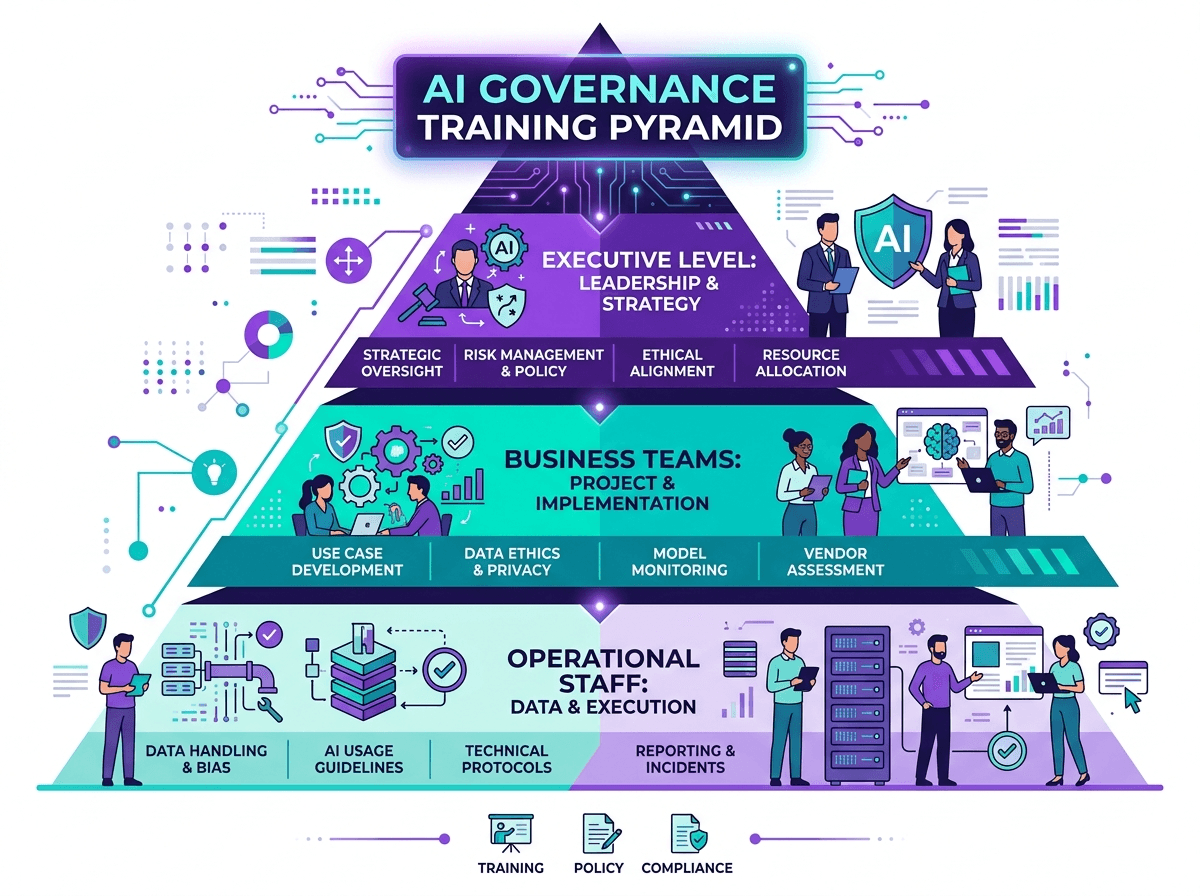
An effective skills development strategy must cover three levels:
- Executive and C-suite level: understand regulatory issues (AI Act, American evolution), integrate AI governance into CSR policy and reporting.
- Business level (HR, legal, marketing, finance): identify at-risk AI uses within your scope, apply validation and documentation procedures.
- Operational level: use AI tools responsibly, recognize warning signals, escalate incidents.
This triptych doesn't improvise itself. It requires contextualized training, anchored in sectoral realities of each company — and regularly updated with regulatory evolution.
Take action: build your AI governance roadmap
Faced with simultaneous acceleration of European and American regulations, the question is no longer "should we prepare?" but "where do we start?".
Ikasia supports French companies through this transition with a structured three-step approach: map existing AI uses and their regulatory exposures, train teams in governance best practices adapted to your sector, then equip your organization with internal policies, audit processes, and monitoring indicators.
Whether you're in the AI exploration phase or already in advanced deployment, a governance maturity assessment is the essential first step.
Schedule a meeting with our experts at ikasia.ai for a free diagnosis of your AI regulatory exposure and build your 2025 action plan together.
AI regulatory developments evolve every quarter. Subscribe to our newsletter at ikasia.ai to stay informed about changes impacting your sector.
Tags
Related courses
Related articles

AI Text Watermarking: What European Regulation Actually Changes for Your Business
Read
OpenAI Faces Accountability: What the Australian Incident Reveals About AI Governance in Enterprise
Read
AI and Young Users: What OpenAI's Strategy for Teens Reveals About AI Governance in the Enterprise
ReadWant to go further?
Ikasia offers AI training designed for professionals. From strategy to hands-on technical workshops.