AI and National Security: What OpenAI's Strategic Shift Really Means for French Businesses

Last week, OpenAI formalized its approach to government partnerships and national security. A strong signal that goes far beyond geopolitical considerations: it is redefining the rules of the game for all organizations relying on AI solutions, including French businesses. Between digital sovereignty, regulatory compliance and economic competitiveness, OpenAI's positioning deserves careful consideration from leaders, CIOs and digital transformation managers.
AI in Service of States: Understanding OpenAI's New Paradigm
OpenAI is no longer simply a language model provider. By formally structuring its partnerships with governments and national security agencies, Sam Altman's company now operates within a logic of co-building critical AI use cases. The announced principles rest on three pillars: responsible deployment, democratic accountability and public safety protection.
In concrete terms, this means that GPT-4o, o1 or their successors can be deployed in highly sensitive contexts — intelligence, cyber defense, threat analysis — subject to strict contractual and ethical frameworks. For French businesses, this shift is doubly significant:
- First, it legitimizes AI use in sectors previously reluctant to adopt it (defense, critical healthcare, essential infrastructure).
- Second, it accelerates regulatory pressure on all organizations using these technologies, whether public or private.
France, with its EU AI Act framework that came into force in 2024, is no exception. French companies must anticipate an environment where AI will be both more powerful and more controlled.
What This Means in Practice for Your Business
OpenAI's alignment with governments is not an abstract techno-political matter. It produces tangible effects on the ground for French businesses, starting today.
1. Evolution of terms of service and SLAs Major AI providers will gradually differentiate their offerings based on the criticality level of use cases. Companies in regulated sectors (banking, insurance, energy, healthcare) will need to adopt tailored contracts, incorporating data sovereignty clauses and algorithmic decision traceability.
2. Strengthened internal governance requirements If OpenAI applies democratic accountability principles to its government partnerships, corporate buyers will logically be expected to demonstrate equivalent governance levels. This involves appointing AI Officers, establishing ethics committees and documenting AI-assisted decision-making processes.
Concrete example: A French industrial group using GPT-4 to automate supplier contract analysis must now precisely document the AI's decision criteria, archive model outputs and provide a human appeal mechanism. This is no longer optional—it's becoming mandatory.
3. Opportunities in public procurement and defense OpenAI's signal opens a window of opportunity for French SMEs and mid-market companies positioned in B2G markets (Business to Government). System integrators, software publishers and consulting firms that master responsible AI deployment have real competitive advantage for responding to the growing number of public tenders.
Digital Sovereignty and AI: The Card to Play for French Businesses
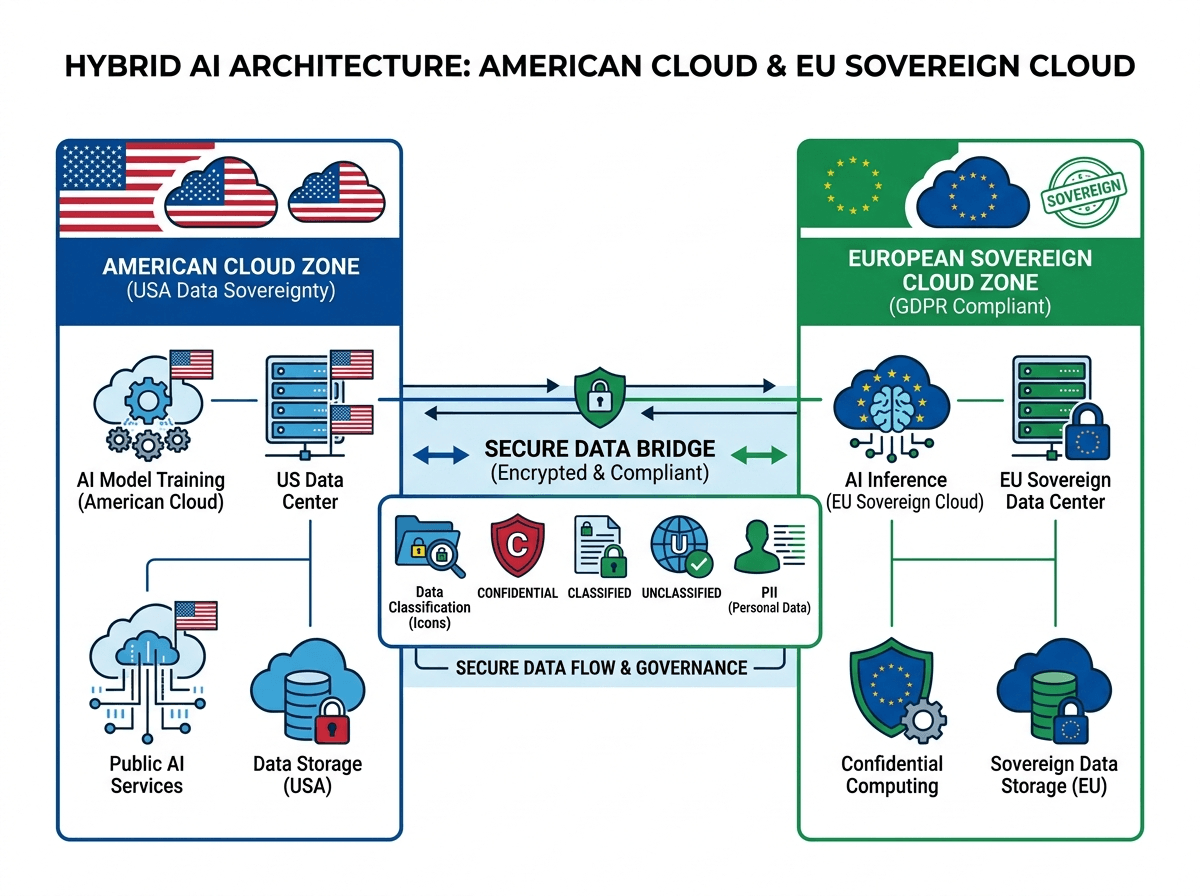
OpenAI's decision to work with governments inevitably raises the sovereignty question. For French businesses, this crystallizes a strategic dilemma: should we rely on American solutions now integrated into other countries' national security architectures, or prioritize European alternatives?
The answer is not binary. A hybrid approach is necessary:
- Use major American models (GPT, Claude, Gemini) for non-critical, high-value-add use cases: content generation, business data analysis, sales assistance.
- Deploy sovereign open-source models (Mistral AI, finely-tuned LLaMA) for sensitive use cases involving personal, strategic or regulated data.
- Implement a RAG architecture (Retrieval-Augmented Generation) hosted on-premise or on certified HDS/SecNumCloud clouds for critical use cases.
Concrete example: A Paris law firm can perfectly use ChatGPT Enterprise to draft non-confidential briefs while deploying a Mistral model hosted in France for analyzing sensitive litigation files. The key: clear mapping of data and associated risks.
This strategic duality is precisely what executive teams must decide on in 2025, with support from their technical and legal teams.
Training Your Teams in Responsible AI: The Imperative of Now
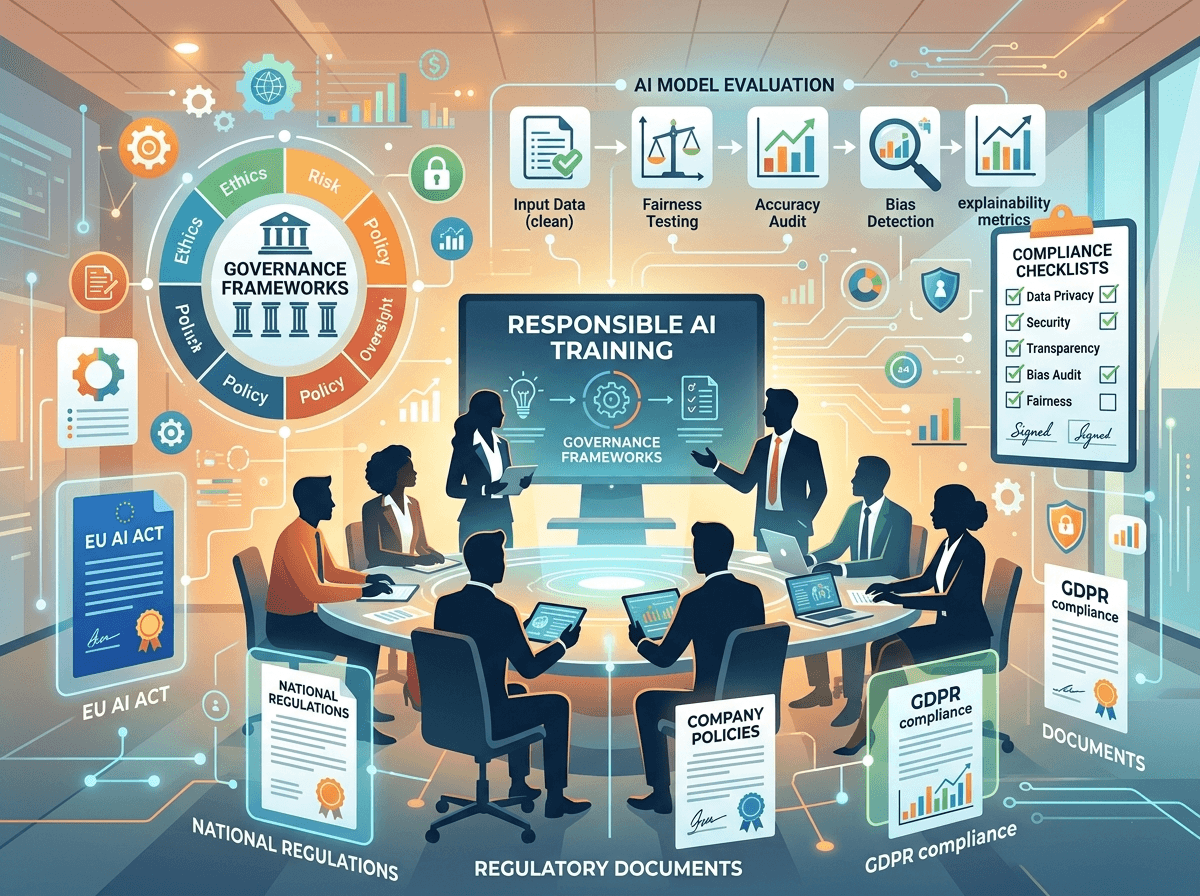
Facing these transformations, employee training is no longer a peripheral HR topic—it's a matter of competitiveness and compliance. OpenAI's shift toward government partnerships sends a clear message: AI becomes a dual-use technology, with proportional responsibilities.
Your teams must be trained on three essential dimensions:
Understanding AI governance stakes: Who decides when AI makes mistakes? How do you document an AI-augmented decision? What are the legal risks of poorly-managed AI? These questions no longer concern only data scientists—they affect managers, legal professionals, procurement officers and salespeople.
Mastering tools with discernment: Knowing how to prompt effectively is good. Knowing how to identify hallucinations, evaluate model output reliability and calibrate the autonomy level granted to AI is better. Skill development must go beyond basic usage.
Integrating compliance reflexes: AI Act, GDPR, regulated sectors… Employees working with AI daily must know the red lines. A salesperson using an AI tool to score prospects must understand the implications of automated decision-making under GDPR Article 22.
At Ikasia, we support French businesses in building these competencies with tailored training programs—from executive awareness to in-depth technical workshops—and consulting missions to structure your AI governance in compliance with the European regulatory framework.
Is your business ready for the responsible AI era?
OpenAI's repositioning on governance and security issues is merely the latest signal of a major trend: AI is entering its phase of institutional maturity. French companies that anticipate this evolution—by training their teams, structuring their governance and choosing their tools thoughtfully—will be those that transform this constraint into sustained competitive advantage.
Discover our training and support programs at ikasia.ai and get ahead of your organization's AI transformation.
Tags
Related courses
Related articles

OpenAI Faces Accountability: What the Australian Incident Reveals About AI Governance in Enterprise
Read
AI and Young Users: What OpenAI's Strategy for Teens Reveals About AI Governance in the Enterprise
Read
Advanced AI Standardization: What French Enterprises Must Anticipate Now
ReadWant to go further?
Ikasia offers AI training designed for professionals. From strategy to hands-on technical workshops.