AI-Powered Phishing: How French Enterprises Can Fight Back with Artificial Intelligence
The threat is silent, sophisticated, and rapidly escalating. In 2024, over 90% of cyberattacks targeting French enterprises begin with a simple email. But these messages no longer resemble the crude attempts of the past, riddled with spelling errors. Today, cybercriminals are armed with generative artificial intelligence to craft phishing emails with surgical precision—personalized, contextualized, and virtually undetectable to the naked eye.
Faced with this emerging threat, an equally powerful response is needed: using AI to fight AI. This is precisely what Amazon Bedrock offers, deploying advanced language models capable of identifying AI-generated malicious emails before they even reach your employees' inboxes. A strong signal for all IT directors and Chief Information Security Officers (CISOs) in French SMEs and mid-market enterprises.
Generative Phishing: A Threat That's Changing Its Face
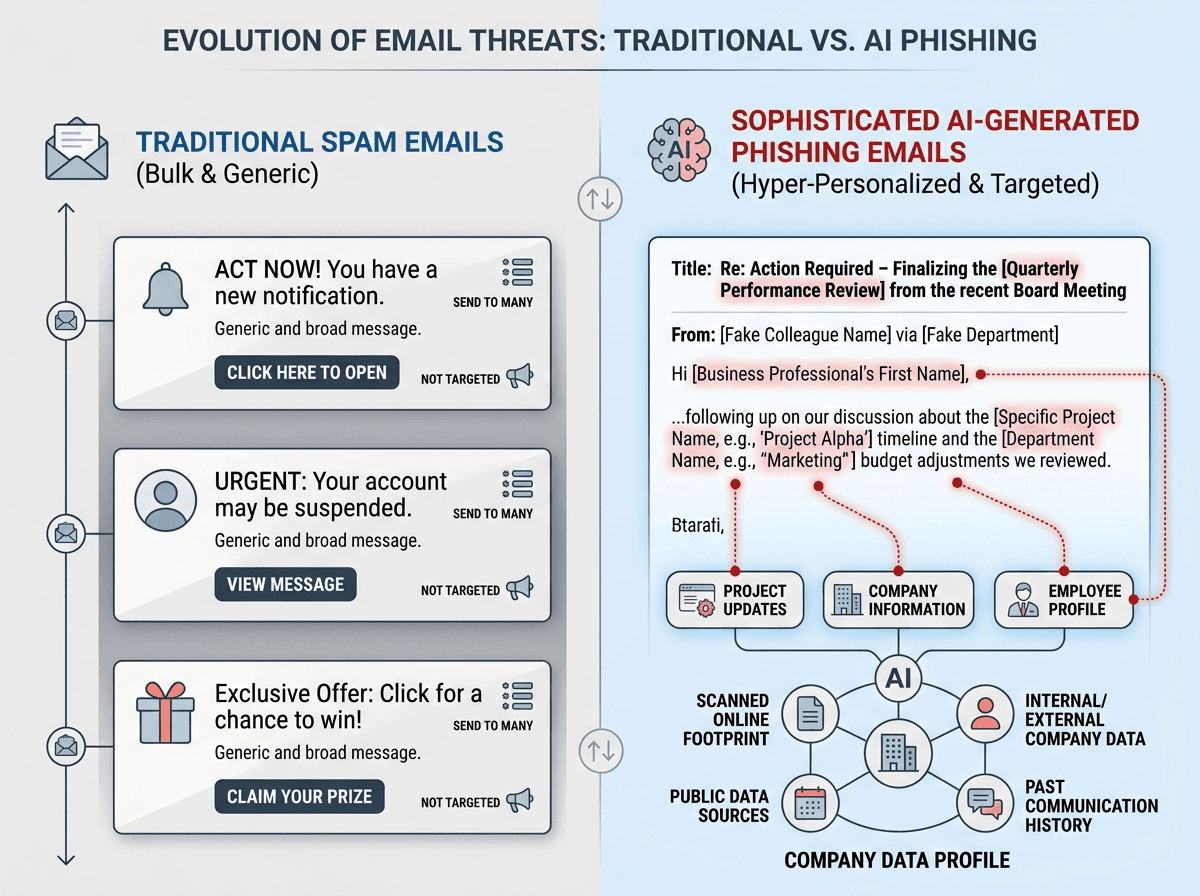
Traditional phishing worked on volume: send millions of generic messages hoping a few would find their target. Generative AI has upended this model. Attackers now use tools like large language models (LLMs) coupled with OSINT (Open Source Intelligence) to gather public information about their targets—LinkedIn profiles, press releases, industry news—and construct ultra-personalized messages.
Imagine an email received by your CFO, signed by a real business partner, mentioning a recent transaction and requesting urgent validation of a wire transfer. All written in perfect English, with the right level of formality. This scenario is no longer science fiction: it happens every week in French enterprises of all sizes.
According to ANSSI, reports of phishing-related incidents in France increased by 38% between 2022 and 2024. And the growing sophistication of attacks renders traditional antispam filters largely insufficient.
How Defensive AI Detects What Humans No Longer See
This is where the approach developed around Amazon Bedrock comes in. Rather than relying on static rules or known threat signatures, foundation models analyze email content in a contextual and semantic manner. They evaluate not only the words used, but also the tone, rhetorical structure, patterns of artificial urgency, subtle inconsistencies between displayed identity and message content.
Concretely, here's what this type of system can detect in a corporate environment:
- Personalized spear-phishing emails with public information about the recipient
- BEC (Business Email Compromise) attacks imitating executives or partners to trigger fraudulent transfers
- Vendor impersonation attempts, particularly common in construction, healthcare, and distribution sectors
- Credential harvesting campaigns disguised as internal notifications (HR, IT, security)
For a French mid-market company with 500 employees, integrating this type of protection layer into its email chain (via Microsoft 365, Google Workspace, or a dedicated gateway) represents a controlled investment for substantial security gains. The return on investment is easily calculated once you consider the average cost of a successful cyberattack in France: €59,000 for an SME, according to the 2023 Hiscox report.
Real Cases: Three French Sectors on the Front Lines
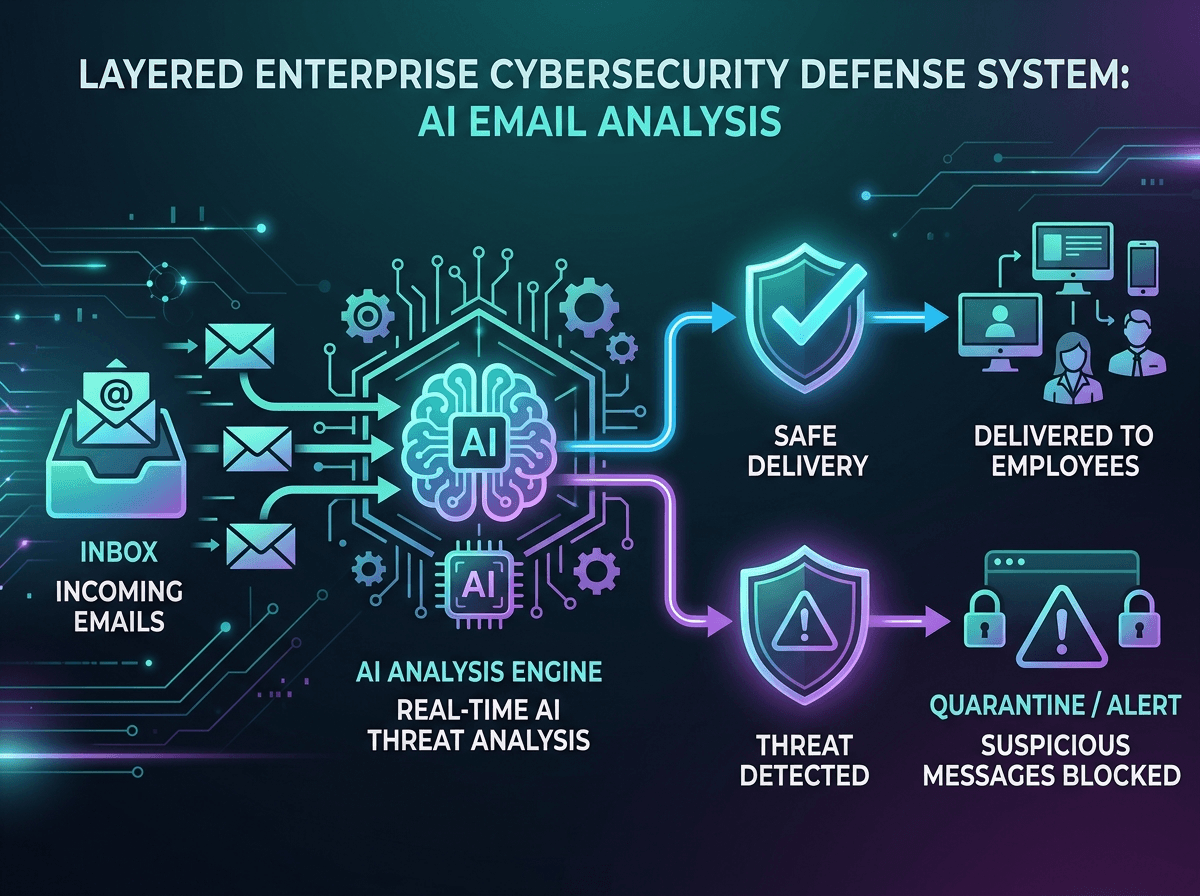
Financial sector and accounting firms are privileged targets. An accounting firm advising small and mid-market businesses may receive dozens of messages daily imitating clients or official bodies (French Tax Authority, Social Security, banks). An AI detection system can analyze in real time the semantic context of each incoming message and raise an alert before any human interaction.
Procurement departments in manufacturing are exposed to fake supplier fraud. A solution based on LLMs can cross-reference the declared identity of the sender with historical supplier relationship data and flag any behavioral anomalies in the message's wording.
Healthcare facilities and nursing homes, already strained by digital transformation, see their administrative teams targeted by emails imitating medical providers or oversight agencies. Defensive AI can play a valuable safety net role for teams with limited cyber risk awareness.
Train Your Teams: Technology Alone Isn't Enough
Deploying defensive AI tools is an essential step, but it doesn't relieve you of the need to invest in human training. Cybercriminals evolve quickly, and an organization whose employees don't understand phishing mechanisms remains vulnerable, even with the best technologies.
Today, team training must integrate three new dimensions:
-
Understanding generative phishing: concretely showing your employees how a malicious email is constructed using AI, what its subtle markers are, and why their usual intuition can fail them.
-
Adopting verification reflexes: even when faced with a perfectly written email, a trained employee will know to use an alternative confirmation channel before any sensitive action (wire transfer, credential sharing, attachment download).
-
Developing a reporting culture: transforming every employee into a security sensor, capable of flagging suspicions without fear of judgment, is one of the most powerful and least costly levers of enterprise cybersecurity.
At Ikasia, we integrate these challenges directly into our applied AI training programs. Because the most sophisticated tool remains inert without trained humans to understand it, use it, and support it daily.
Take Action with Ikasia
The threat of AI-generated phishing is not a distant trend: it's striking French enterprises of all sizes today. The good news is that the tools to address it exist, are accessible, and can be deployed progressively according to your digital maturity.
Ikasia supports leaders, IT teams, and employees of French enterprises to understand these new threats, assess their exposure, and implement solutions combining AI technology and human training.
Do you want to conduct an AI and cybersecurity maturity audit of your organization, train your teams on the risks of generative phishing, or explore solutions adapted to your context? Visit ikasia.ai to speak with our experts and build your roadmap together.
Tags
Related courses
Related articles
Structured Outputs for Claude on Amazon Bedrock: The End of Unpredictable APIs for French Enterprises
Read
OpenAI on Amazon Bedrock: What Asia-Pacific Availability Means for French Enterprises Going Global
Read
Claude on Amazon Bedrock in Asia: What AI Data Sovereignty Really Means for French Enterprises Operating Globally
ReadWant to go further?
Ikasia offers AI training designed for professionals. From strategy to hands-on technical workshops.