AWS AgentCore Payments: When Your AI Agents Can Pay for Their Own Services — What It Means for Your Business

The boundary between artificial intelligence and real economic action has just crossed a decisive threshold. Amazon Web Services has announced the preview availability of AgentCore Payments, a feature integrated into Amazon Bedrock that enables AI agents to execute payments in complete autonomy, without human intervention for each transaction. For digital leaders and CIOs, this is not merely a technological curiosity: it signals a profound transformation in how business processes will automate in the coming months.
In a context where enterprises are seeking to industrialize their AI use cases while controlling costs and risks, AgentCore Payments provides concrete answers — but also raises governance questions that would be imprudent to ignore.
What AgentCore Payments Fundamentally Changes in AI Agent Architecture
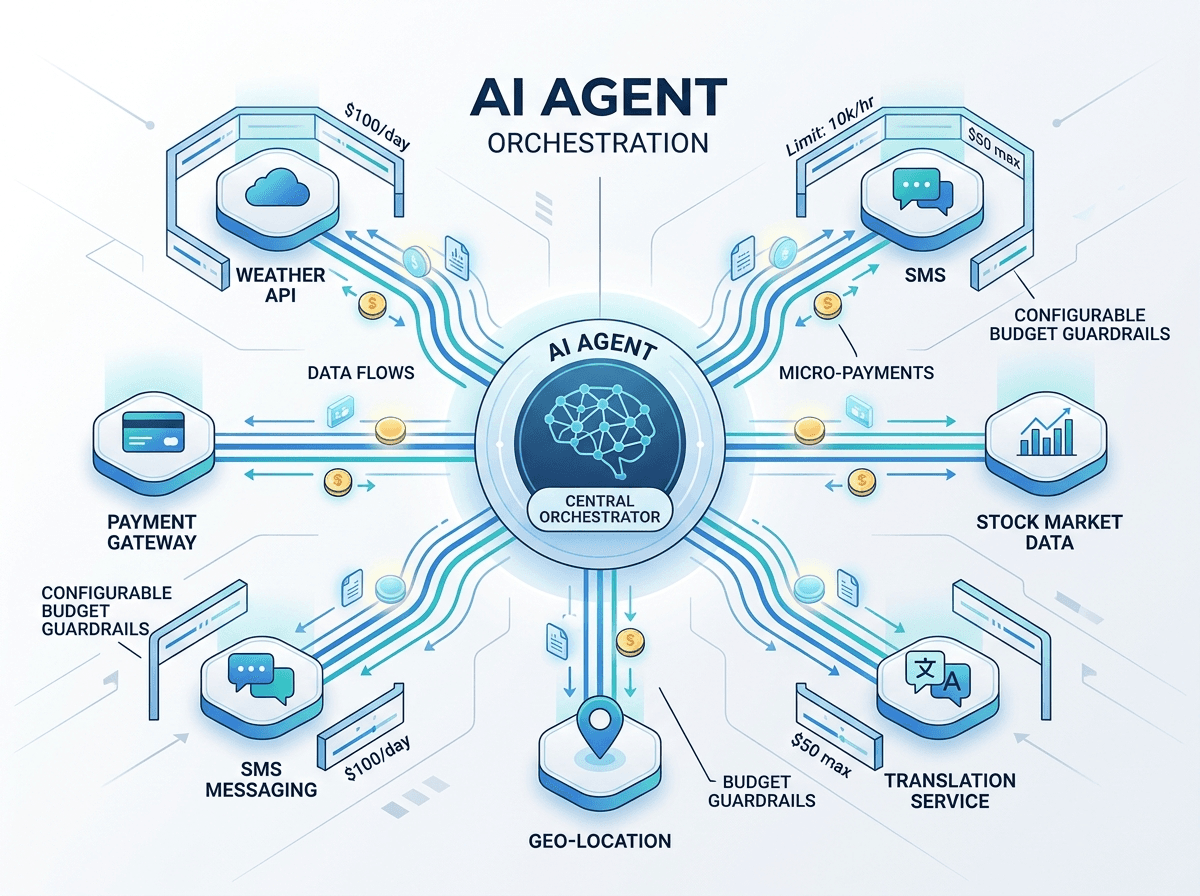
Until now, an AI agent could analyze, decide, and recommend — but it stopped at the threshold of financial action. Each integration with a paid external service required manual billing configuration, human approval workflows, and delays incompatible with the promise of real-time automation.
AgentCore Payments solves this bottleneck in three dimensions:
Instant payments without per-provider configuration. The agent can access paid third-party services — data APIs, verification tools, processing services — without the technical team needing to negotiate and configure billing integration for each one. This is a considerable operational gain for enterprise AI architects.
Stablecoin support for micro-transactions. This is arguably the most innovative component: by leveraging stablecoins, AgentCore makes transactions under one cent economically viable. This opens the door to extremely granular pay-per-use consumption models, previously impossible with traditional payment systems whose fixed fees would absorb most of the value.
Configurable spending guardrails. Budget caps and transaction limits can be set with fine granularity — by agent, by operation type, by period. This directly addresses legitimate concerns from finance leaders and security officers regarding agents acting without control.
Concrete Applications for Enterprises: Three High-Potential Scenarios
It would be reductive to confine AgentCore Payments to the tech startup world. The most immediate use cases concern sectors well-represented in the business ecosystem.
In financial services and insurance, an underwriting agent could, in real time, pay for access to alternative scoring bureaus, hyperlocal weather data to assess risk, or identity verification services — all within an automated decision-making process with complete traceability of every expense.
In logistics and supply chain, an agent responsible for supply optimization could query and pay for real-time data feeds on commodity prices, port delays, or available transport capacity, autonomously arbitrating between multiple data providers based on their current value-for-money ratio.
In consulting and professional services, imagine an agent orchestrating the production of a due diligence report: it pays per-use for legal APIs, sectoral databases, certified translation services — while remaining within a budget envelope defined by the project manager, with zero administrative intervention between each request.
These scenarios are no longer science fiction. They become pilot projects achievable today for enterprises that have structured their agentic AI practice.
Governance and Compliance: Questions Enterprise Leaders Must Address
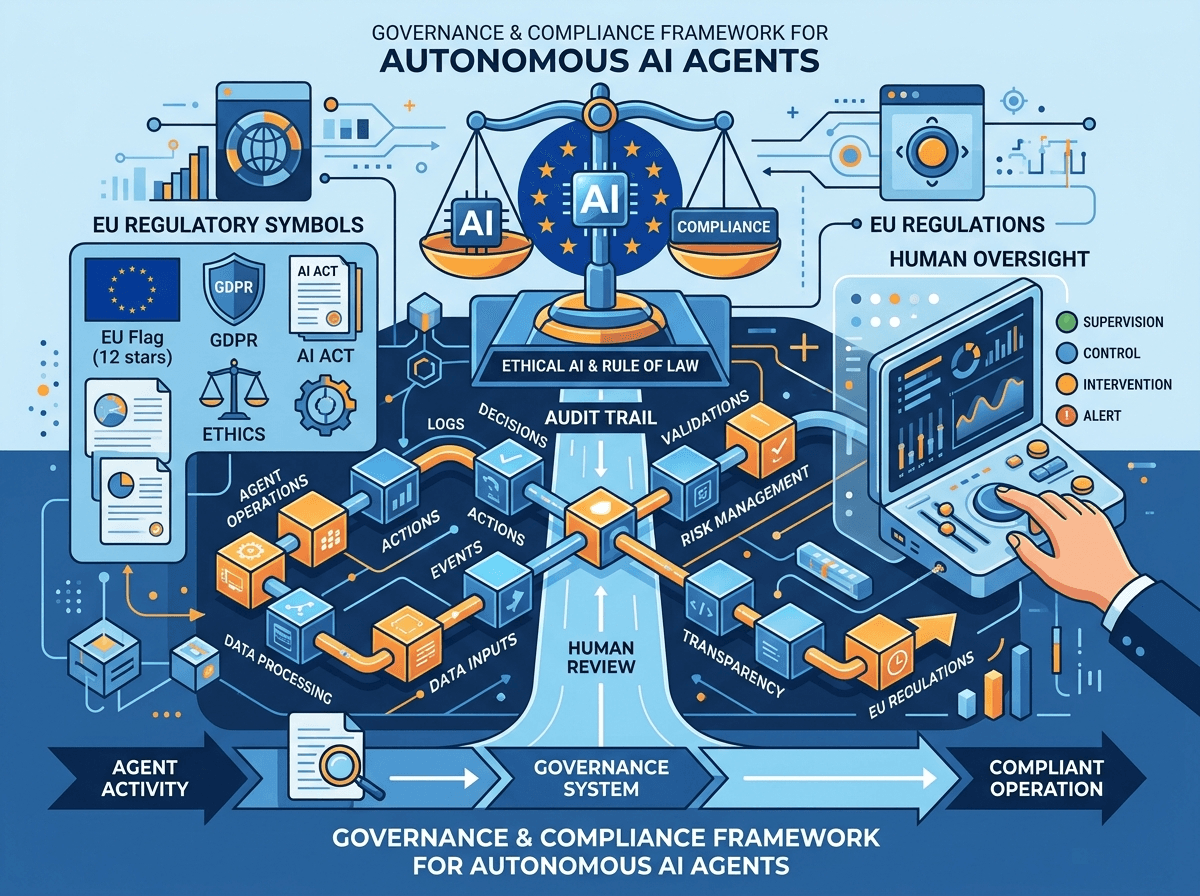
Technological enthusiasm must not obscure compliance issues, particularly sensitive in France and the European Union.
The question of traceability and auditability is central. Finance leaders and external auditors will demand a complete audit trail for each transaction executed by an agent. AgentCore provides logging mechanisms, but it is up to enterprises to define their archival and accounting reconciliation policies in a context where the principal is a machine.
The question of legal responsibility is equally open. Who is responsible for a transaction executed autonomously by an AI agent? The European regulatory framework, notably the AI Act, requires reflection on the classification of these systems and associated human supervision obligations. Enterprises operating in regulated sectors — banking, insurance, healthcare — must imperatively engage their legal and compliance teams before any production deployment.
Finally, the use of stablecoins raises specific questions regarding MiCA (Markets in Crypto-Assets) regulation, applicable in the EU since 2024. This point deserves case-by-case analysis depending on the nature of intended transactions.
The spending guardrails integrated into AgentCore are a first technical response to these issues, but they do not replace a documented AI governance policy validated at board level.
Training Your Teams in Agentic AI: The Urgency of Structured Capability Building
The arrival of capabilities like AgentCore Payments reveals a growing gap between what technology enables and what teams in enterprises are capable of designing, deploying, and overseeing responsibly.
The required capability development does not concern only developers. Project managers, business owners, finance teams, and legal teams must all develop shared literacy in agentic AI: understanding what an agent can do, how to define its constraints, how to audit its actions, and how to identify situations where human oversight remains essential.
Concretely, three levels of training must be planned:
- Decision-maker awareness: understand opportunities and risks associated with autonomous AI agents to make informed investment decisions.
- Technical team training: master Amazon Bedrock architecture, agent design with guardrails, and integration of capabilities like AgentCore Payments into existing workflows.
- Business and compliance team training: define usage policies, validation processes, and control indicators adapted to an environment where agents act on your behalf.
At Ikasia, we support enterprises in this capability journey, from strategic awareness to technical implementation, with tailored programs rooted in your sector realities.
Agentic AI capable of acting financially in complete autonomy is no longer a distant horizon: it is a reality available in preview today and in production tomorrow. Enterprises that have structured their governance, trained their teams, and experimented starting now will gain a decisive competitive advantage.
Would you like to assess your organization's maturity regarding agentic AI and build an adapted roadmap? Contact Ikasia's experts at ikasia.ai for a personalized assessment and training programs calibrated to your challenges.
Tags
Related articles

AI Code Generation in Enterprise: How Amazon Bedrock Guardrails Protect Your Workflows Without Compromising Productivity
Read
AI Model Lifecycle in Amazon Bedrock: How to Protect Business Application Continuity
Read
Master Your AI Costs in Enterprise: Amazon Bedrock Projects Changes the Game
ReadWant to go further?
Ikasia offers AI training designed for professionals. From strategy to hands-on technical workshops.