Pando, OpenAI's Git: What Codex's Infrastructure Reveals About the Future of Enterprise Software Development

The speed at which artificial intelligence is transforming software development has now reached a point where it exceeds the capabilities of tools that have served the industry for decades. Git, the version control system used by virtually all development teams worldwide, was not designed to handle thousands of AI agents working in parallel on the same code repository. This is precisely the problem that OpenAI has just solved with Pando, a Git-compatible backend designed to support the scale of development that Codex makes possible. For French companies betting on AI to accelerate their software production, this announcement is not just a technical detail—it's a strong signal about the direction the industry is heading.
Why Git Was Reaching Its Limits Against AI Agents
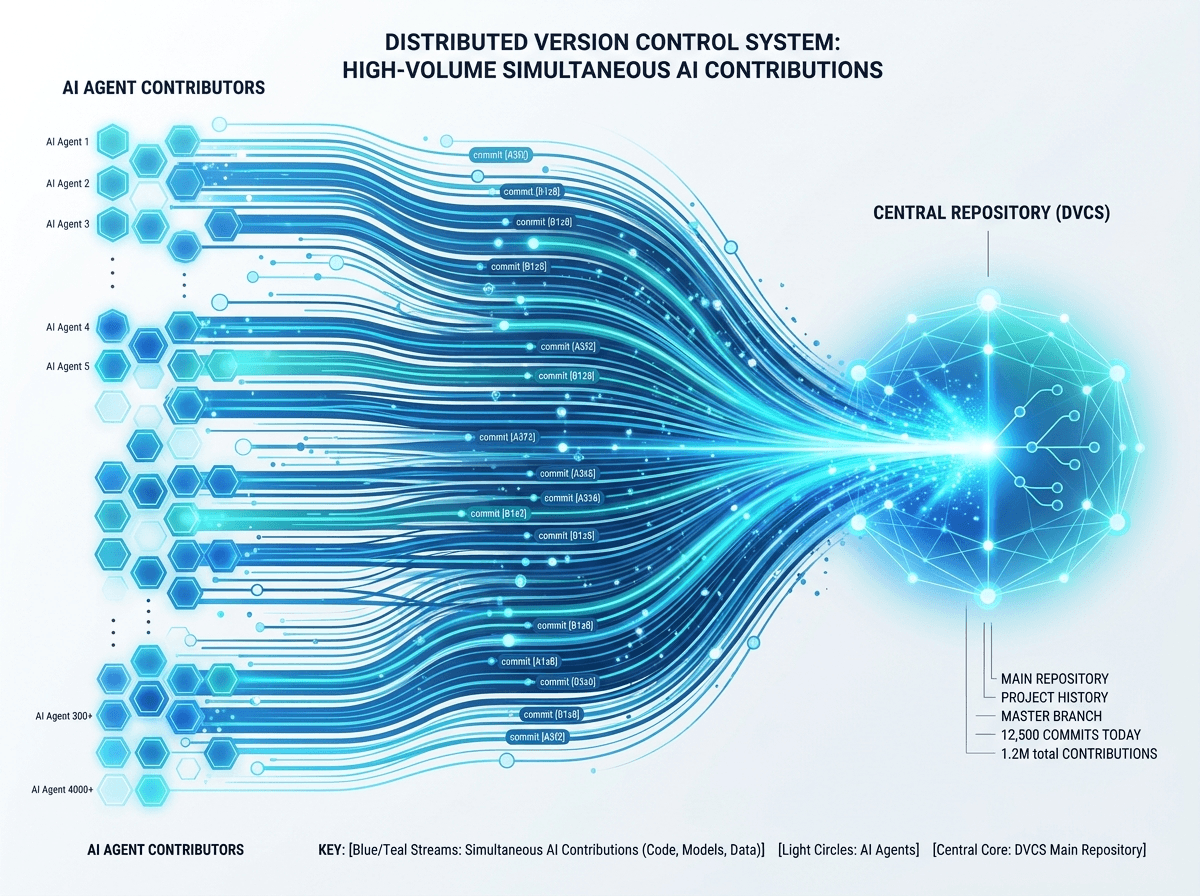
Git was invented by Linus Torvalds in 2005 to enable humans to collaborate efficiently on source code. Its design relies on implicit assumptions: commits spaced out over time, branches managed by individual developers, merges negotiated between human teams. These assumptions crumble the moment AI agents like Codex are introduced—agents capable of generating, modifying, and testing code continuously, at a pace humans simply cannot match.
At OpenAI, deploying Codex at scale immediately revealed critical bottlenecks: read/write operations multiplied exponentially, merge conflicts became unmanageable, and the overall performance of the versioning system collapsed under the load. The solution was not to optimize Git marginally—it was to rethink the underlying architecture while maintaining compatibility with the existing Git ecosystem. Pando was born from this necessity: a distributed backend designed to absorb volumes of operations with no comparison to what human teams generate, while remaining transparent to tools and workflows already in place.
What Pando Reveals About the Future of Development Teams
The very existence of Pando confirms a trend that French CIOs and CTOs must integrate into their roadmaps: AI-assisted software development is no longer a marginal productivity gain—it's a complete overhaul of the code production model. When a single AI agent can generate in minutes the equivalent of what a team would produce in several days, the infrastructure supporting these workflows must be completely rethought.
In concrete terms, for a French banking company deploying AI agents to automate the generation of microservices compliant with DORA or GDPR regulations, the question of versioning scalability becomes immediately critical. Similarly, a SaaS software publisher using Codex or equivalent tools to generate feature variants for A/B testing will quickly hit the same limits OpenAI encountered. Organizations that anticipate these infrastructure constraints today will gain a decisive edge over those who discover the problem in production.
The implications are also organizational: when AI agents become active contributors to code repositories, processes for review, validation, and code governance must evolve. Who validates the code of an agent? What branching rules apply? How do you trace responsibility for a bug introduced by an autonomous system? These questions, still theoretical for many, become operational as soon as tools like Codex are adopted at scale.
Concrete Applications for French Enterprises
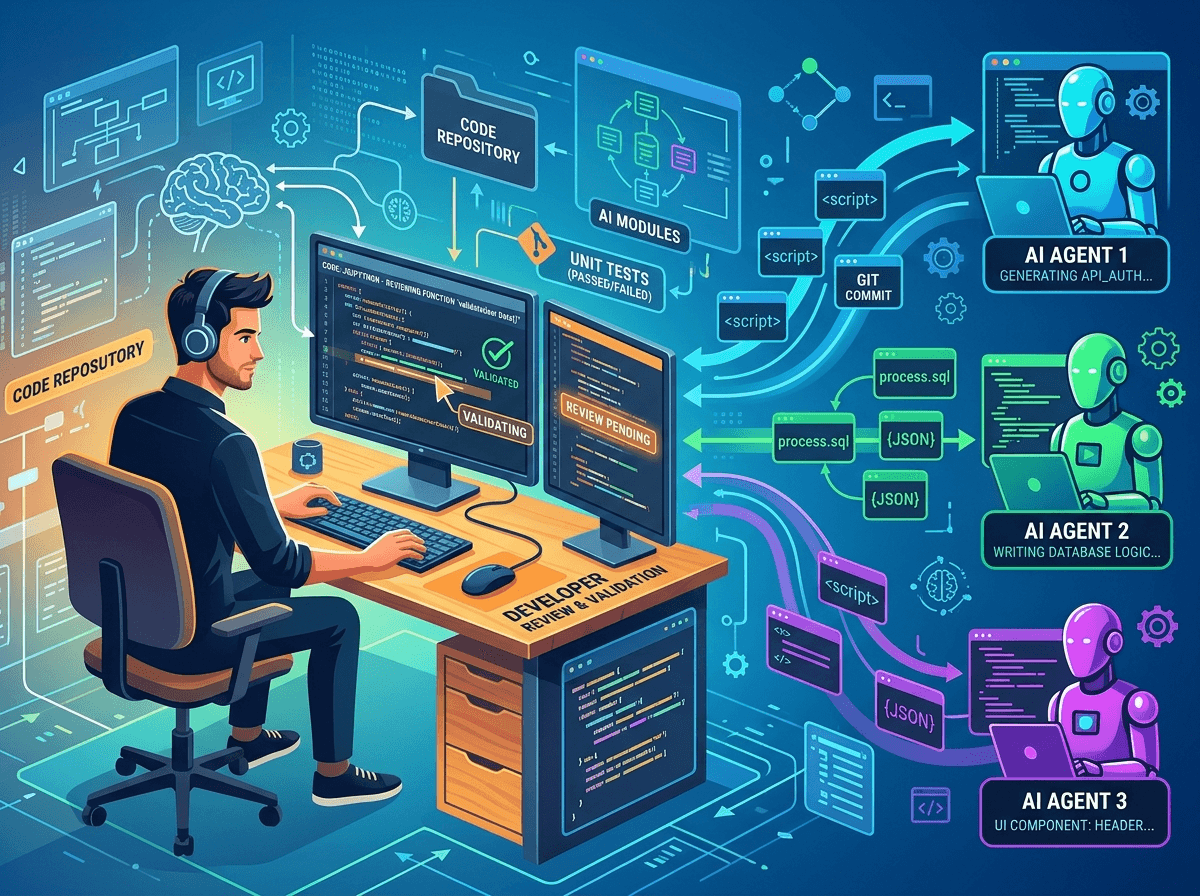
Let's look at a few sector-specific examples to ground these issues in the reality of French organizations:
In manufacturing and industry: groups like Schneider Electric or Michelin, which develop digital twins and complex embedded systems, could deploy AI agents to automatically generate simulation or test code. The ability to version thousands of code variants in parallel becomes a direct competitive advantage in R&D cycles.
In fintech and financial services: development teams at major French banks and neobanks already use AI code assistants. The next step—autonomous agents that generate data pipelines or API connectors in response to business specifications—will require exactly the type of infrastructure that Pando represents.
In the public sector and IT service providers: digital services companies managing projects for the State or local governments could use AI agents to accelerate code production while maintaining strict quality and traceability standards—a requirement in public procurement.
In all these cases, the lesson from Pando is the same: adopting generative AI for code without rethinking the underlying infrastructure is building on sand.
Training Teams for This New Reality: A Strategic Imperative
Pando's announcement highlights a skills gap that will quickly become critical in French enterprises. Developers, DevOps engineers, and architects must now understand not only how to use AI tools for coding, but also how to design environments where AI agents can operate safely, traceably, and efficiently.
This involves training at multiple levels: understanding distributed architectures and next-generation version control systems, implementing governance policies for AI-generated code, defining hybrid human/machine code review workflows, and managing risks related to the growing autonomy of development agents. Teams that master these subjects will be those that truly benefit from the revolution that tools like Codex inaugurate—others risk being left with technical and organizational debt difficult to overcome.
Skills development concerns more than just technical profiles. Product managers, project managers, and IT managers must understand the new dynamics of code production to effectively lead teams augmented by AI. The boundary between human decision and machine execution is shifting—and management must adapt accordingly.
Is your organization ready for the era of AI development agents? At Ikasia, we help French companies understand and strategically adopt artificial intelligence—from training your technical teams to defining your AI roadmap. Contact us at ikasia.ai for a personalized assessment and discover how to transform these technological changes into concrete competitive advantage for your organization.
Tags
Related articles
Project Camellia: When OpenAI Builds Data Centers, French Businesses Must Rethink Their AI Strategy
Read
From Weeks to Hours: How Agentic AI Transforms Software Delivery at Endava (And What French CIOs Must Learn)
Read
OpenAI + Dell + Codex: AI-Powered Software Development Comes to Your Servers — What Changes for French Enterprises
ReadWant to go further?
Ikasia offers AI training designed for professionals. From strategy to hands-on technical workshops.