Prompt Caching: How to Reduce Your Enterprise AI Agents Costs by 80%

Your AI agents re-read their entire context at every step. It's like asking a consultant to review a 500-page file before each meeting — even though 90% of the content hasn't changed. This inefficiency, long accepted as a technical inevitability, now has a concrete solution: prompt caching, now available for OpenAI models deployed on Amazon Bedrock. For enterprises industrializing their AI usage, this represents a major economic and operational turning point.
The "Groundhog Day" Problem in Your AI Workflows
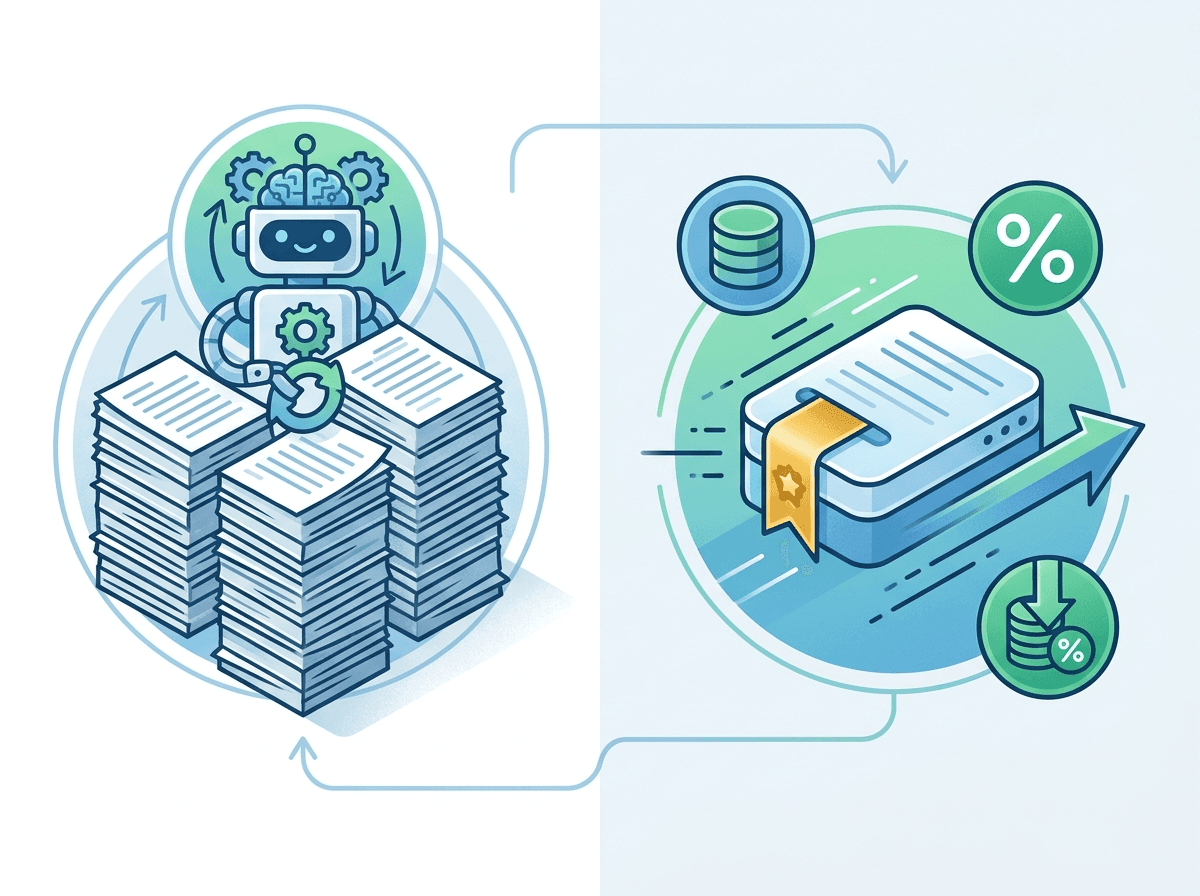
Imagine an AI agent tasked with handling customer service requests from your after-sales department. At each interaction, this agent must receive and reprocess its entire context: system instructions, available tools, conversation history, internal policies, relevant product sheets. Round after round, step after step, it "re-reads" everything from the beginning — like Bill Murray's character in Groundhog Day, condemned to relive the same day indefinitely.
This behavior is not incidental. In a typical business conversational agent, fixed context (instructions, tools, knowledge base) can represent 70 to 90% of the tokens sent with each call. This translates into:
- Inference costs that skyrocket as conversations grow longer
- Increased latency hurting user experience
- Computational waste incompatible with responsible AI practices
The good news: Amazon Bedrock introduces prompt caching for OpenAI models (GPT-4o and its variants), allowing you to memorize stable portions of context between successive calls. The model no longer needs to reprocess what it already knows.
How Prompt Caching Works and Why It's a Strategic Lever
The principle is elegant in its simplicity: you identify the invariant portions of your prompt (system instructions, tool definitions, reference documents) and mark them as cache candidates. Amazon Bedrock then stores the processing result of these segments. On subsequent calls, if these portions are identical, the system reuses the cached results rather than recalculating everything.
In practice, the observed gains are significant:
- Reduction in input costs up to 80% on cached tokens
- Latency decrease of 30 to 50% on successive calls
- Improved scalability for high-volume deployments
For an enterprise deploying an internal support AI agent processed 10,000 times per day with an 8,000-token context, monthly savings can quickly reach several thousand euros — without any compromise on response quality.
From an architecture perspective, the strategy consists of structuring your prompts in layers: first the most stable elements (cached with priority), then semi-dynamic elements (recent history), finally the current user request. This design discipline becomes a genuine competitive advantage for technical teams.
Concrete Applications for Enterprises
This technical advancement takes on full meaning when applied to the most common use cases in organizations:
Customer service and technical support: An agent that masters terms of service, product documentation, and internal procedures no longer needs to reload them with each exchange. The cache memorizes this regulatory and product foundation — particularly relevant in regulated sectors like banking, insurance, or healthcare where reference materials are voluminous but stable.
Legal and compliance assistants: Law firms and legal departments deploying document analysis agents can cache their entire regulatory corpus (GDPR, labor law, sector-specific regulations). Only the document submitted for analysis changes — everything else is stored in memory.
Content generation agents: Marketing teams using AI agents to produce content consistent with their editorial guidelines can cache this charter, brand glossary, and reference examples. Each new content request thus benefits from instantly available brand context.
ERP and business systems: Agents connected to ERPs (SAP, Sage, etc.) that must know data structure, business rules, and available APIs can cache this application knowledge layer, transmitting only genuinely new transactional data.
In all these cases, the pattern is identical: separate what is stable from what is dynamic, and entrust the cache with the structural memory responsibility of the agent.
Training Your Teams in a New AI Design Discipline
Introducing prompt caching is not just about activating a technical parameter. It involves an evolution of skills within teams designing and maintaining AI agents in enterprise environments.
Developers and prompt engineers must now integrate a new dimension into their practice: thinking in terms of relative stability of information. Which parts of the prompt change with each call? Which remain fixed during a session? Which are permanent? This mapping becomes a design exercise in its own right.
Solution architects must rethink agent pipelines to maximize cache reuse — which may involve reordering prompt elements, standardizing system instructions, or creating libraries of reusable prompt fragments.
Finally, product managers and business decision-makers need to understand the economic impact of these design choices to arbitrate investments: an agent poorly designed from a caching perspective can cost three to five times more than an optimized agent, for identical results.
At Ikasia, we support enterprises in this skills development journey, from executive awareness to developer technical training, including audits of existing AI architectures. Mastering the total cost of ownership (TCO) of your AI agents begins with training adapted to your systems' realities.
Prompt caching is not a marginal optimization reserved for tech giants. It's a mature AI engineering practice, now accessible to enterprises of all sizes via Amazon Bedrock, which directly determines the profitability and scalability of your autonomous agent projects.
Are you deploying or considering deploying AI agents in your organization? Discover how Ikasia can help you design high-performing and economically viable architectures. Visit ikasia.ai to explore our training and AI consulting services applied to enterprise.
Tags
Related courses
Related articles

GPT-5.6 on Amazon Bedrock: How Prompt Caching Reduces Your AI Costs by 80% and Transforms Enterprise Workflows
Read
Claude Sonnet 5 on AWS: Next-Generation AI to Transform Your Team's Productivity
Read
OpenAI on Amazon Bedrock: What French Enterprises Need to Know About the New Era of Hybrid Cloud AI
ReadWant to go further?
Ikasia offers AI training designed for professionals. From strategy to hands-on technical workshops.